
On the last Saturday of October, bottles, fireworks and eggs flew through Berlin’s Prenzlauer Berg, and shops were looted on Frankfurt’s Zeil shopping street. The youth protest wave that began in France has reached Germany, and youth riots are following in its wake. It is fair to ask who is pouring fuel on the fire. The answer is simply not as straightforward as many would like.
A recap is in order, because the wave has moved fast. As Innohub’s earlier analyses showed, the bill already fell on businesses on the streets of Paris. In France, the school students’ movement had been building for weeks when, on 17 October, demonstrations against the cost of living and the state of schools spun out of control nationwide. In Limoges, masked protesters set fire to the 143-year-old town hall, and according to Prime Minister Sébastien Lecornu, 1,200 people had been arrested across the country. A week later, bottles and stones were thrown in Italian cities, and police in eight cities briefly detained 371 people, 110 of them minors. In The Hague, shopkeepers boarded up their windows in advance as messaging groups circulated calls for a Gen Z protest and, in part, for disorder and vandalism; some shopkeepers received threats.
In Germany, an initiative called Gen Z regelt called for peaceful demonstrations in around thirty cities on 31 October. Police counted more than 65,000 people on the streets, the organisers around a hundred thousand, and the demands covered school funding, the cost of living and the climate, along with opposition to conscription. The day passed off largely peacefully. The evening did not. In Berlin, an evening march separate from the peaceful demonstration at the Brandenburg Gate set off from Rosenthaler Platz towards Prenzlauer Berg, and the organisers of the Brandenburg Gate demonstration said they were not responsible for the evening march. Police put the march at around 3,500 people, against an expected 500. Bottles and fireworks were thrown from the crowd, stones and eggs at nearby shops, and 27 police officers were slightly injured. In Frankfurt, more than a hundred officers were injured, and the 54 suspects arrested were aged between 13 and 29. Nationwide, according to the news agency dpa, there were at least 250 arrests.
One detail of the Berlin case deserves attention. According to the city’s interior administration, both left-wing extremist actors and actors from so-called foreign-related extremism (auslandsbezogener Extremismus) mobilised for the protests, and the aim was probably to hijack them and radicalise them. The Federal Office for the Protection of the Constitution had issued the same warning: parts of the left-wing extremist scene could join in, along with individual groups from foreign-related extremism. The German term refers to extremist groups operating in Germany whose roots lie in conflicts abroad, including in the Middle East. It is a serious warning, but it is not a claim that a foreign state is directing the streets of Berlin.
So what do we know about foreign influence? More than many think. On 7 October, the French foreign ministry summoned Iran’s ambassador because false content about the school students’ movement had been spread from the official accounts of Iran’s foreign ministry; Paris called that content entirely unacceptable. Alliance4Europe, a European network of civil society organisations, reviewed more than 547,000 posts in nine languages. According to its findings, the Russian Pravda network published 1,018 articles on the French unrest across 28 websites, and a bot network linked to the Doppelgänger operation sent 639 coordinated messages in French, German, English and Polish. They were seen around 7.4 million times in the six weeks before 17 October. One of the network’s slogans gives the game away: every euro sent to Kyiv is stolen from our common welfare.
Moscow did not create young people’s frustration, but it is doing everything it can to turn that frustration against Ukraine and the European Union.
It matters just as much to say what we do not know. President Emmanuel Macron has said there is no evidence of foreign interference in the events themselves, even though information manipulation has taken place in their aftermath. Alliance4Europe reaches the same conclusion: the protests originated in France, and no evidence of a foreign instigator was found. An EU official speaking anonymously told Euronews that the EU has no information or firm confirmation that foreign information manipulation was behind the events, and according to the Financial Times, EU regulators are examining possible online influence by Russia, Iran and Algeria. That is a suspicion, not an established fact. As for Germany, no official information has so far been made public showing that the violence in Berlin or Frankfurt was organised by a foreign state. The open question is who spread the calls to gather, and from which accounts. Answering it is a job for the security authorities, not for a columnist’s guesswork.
Two mistakes follow from this, and Europe must avoid both. The first is naivety. The Kremlin’s playbook has been the same for years: it does not invent fault lines but finds them and drives a wedge into them, and this time its messages were circulating in German and Polish weeks before the first window was smashed in Frankfurt. The second mistake is the convenient scapegoat. If every stone is explained away as thrown by Moscow, politicians get off lightly. At the heart of the protests are prices, housing, wages and crumbling public services, and these are real concerns. The same goes for the debate about the rioters’ backgrounds. Hesse’s interior minister, Roman Poseck, described the violent crowd as largely of migrant background, but according to dpa most of those arrested in Frankfurt were German citizens. Neither fact justifies branding an entire population group, because a crime always belongs to the person who commits it.
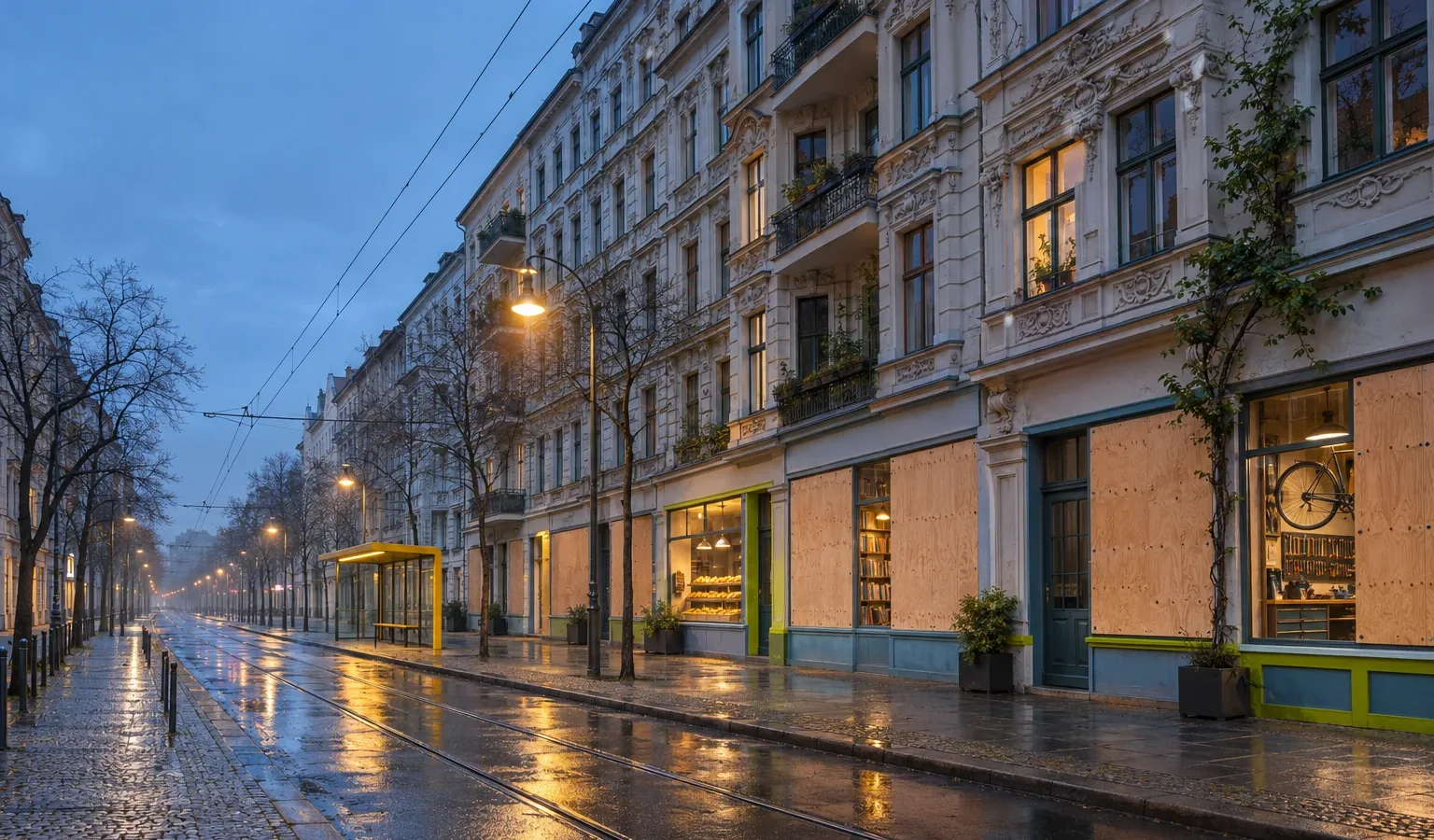
Whatever the cause, it is the business owner who pays. Five shops were looted on Frankfurt’s Zeil, stones were thrown at neighbourhood shops in Berlin, and in The Hague the plywood went up before anything had happened at all. The Dutch business organisations VNO-NCW and MKB-Nederland called the sight deeply sad. Few small high-street retailers have a communications department or a rainy-day fund. Most have an insurance excess, a lost evening’s trade and the question of whether people will dare to come back to the town centre. A city’s vitality is built on exactly these shops, and it is surprisingly fragile.
So what should be done? First, peaceful protest and violence must be clearly kept apart: the former is a right to be protected, the latter a crime that must be met with a swift sentence. Second, the EU’s Digital Services Act must be used with its full weight, because platforms are increasingly writing reality. Platforms must stop coordinated inauthentic amplification now, and the Commission cannot sit back and wait for the risk to become systemic. A capability like France’s Viginum, able to detect foreign digital interference, belongs in every member state and in a shared situational picture. Third, young people’s worries about housing, schools and prices must be taken seriously, and the answer lies in competitiveness, a functioning single market and the removal of obstacles to housebuilding. Subsidies will not solve it.
Ukraine has to be addressed head-on, because that is precisely the route by which the Kremlin is trying to redirect young people’s frustration. The claim that support for Ukraine is taken away from the young is a story Moscow’s networks spread diligently. The reality is the opposite. Ukraine is defending the freedom and security of all of Europe, including that of the young Berliners and Parisians now demanding a better future for themselves. That is why support for Ukraine must remain strong, militarily, economically and politically. It defends the future of Europe’s young people, because without security there is no growth, no investment and none of the jobs the young are quite rightly demanding. Russia’s own troubles do not free Europe from this responsibility; they make it greater.
Ukrainians themselves are showing what resilience means. In a survey published in June by the American Chamber of Commerce in Ukraine (AmCham Ukraine) and Citi, 92 per cent of responding member companies were fully operational in the midst of a full-scale war now more than four years old, and 87 per cent planned to maintain or increase their investments. Every European entrepreneur understands what that takes when missiles strike infrastructure and employees are called up for military service. To Ukraine’s entrepreneurs: your resilience deserves the respect of all Europe. You are keeping your country going and, with it, part of Europe’s security, and you should not have to do it alone.
Gen Z regelt has announced that it will join new protests roughly three weeks after the October demonstrations. We will then see whether Europe has learned to tell genuine concern, street violence and foreign incitement apart. If it has not, the bill will once again fall on those who raise the shutters of their own shop in the morning.
Sources
- French Ministry for Europe and Foreign Affairs: Iran – Convocation de l’ambassadeur de la République islamique d’Iran (7 October 2026) — Summoning of Iran’s ambassador over disinformation about the school students’ movement
- Alliance4Europe: EU Unrest Report – How France’s October 2026 protests were manipulated, then retold abroad (October 2026) — Figures on the Pravda and Doppelgänger networks; conclusion on the domestic origin of the protests
- Euronews: No evidence foreign powers sparked Europe’s riots, but they exploited them (21 October 2026) — Statements by Macron, the Commission and Italy’s defence minister
- Il Sole 24 Ore / Financial Times: EU investigates pro-Russian disinformation linked to street protests (21 October 2026) — EU regulators’ inquiry; Russia, Iran and Algeria suspected
- Euronews (German edition): Gen-Z-Proteste in Berlin – Radikale Gruppen übernehmen (31 October 2026) — The Berlin march, turnout and the interior administration’s assessment
- Stuttgarter Nachrichten: Bilanz einer Krawallnacht (1 November 2026) — 27 police officers slightly injured in Berlin; new protests in three weeks
- dpa-AFX / ARIVA: Krawalle nach Jugend-Demos (1 November 2026) — Turnout figures, the Frankfurt arrests and more than 250 arrests nationwide
- Euronews: Wages vs prices – the economic pressures behind Europe’s protests (19 October 2026) — The economic background to the protests
- IamExpat: Shops in The Hague board up ahead of Gen Z protest on Saturday (30 October 2026) — Shops in The Hague boarding up; calls in messaging groups
- NL Times: Interior minister: alarming messages about Gen Z riots in Dutch cities this weekend (30 October 2026) — Comment from VNO-NCW and MKB-Nederland; calls in messaging groups
- ZDFheute: Krawalle und Plünderungen überschatten “Gen Z regelt” (1 November 2026) — Events in Frankfurt, Cologne and Berlin; comments from the authorities
- Münchner Merkur / leinetal24: Verfassungsschutz warnt vor Linksextremisten (28 October 2026) — Advance warning from the Federal Office for the Protection of the Constitution
- France 24: Yellow vests throw their weight behind mounting student protests (17 October 2026) — Events in France on 17 October, the Limoges town hall and the arrests
- Euronews: Protests sweep across Europe (24 October 2026) — Detentions in Italy and the minors among them
- AmCham Ukraine: 92% operational, 87% investing – business confidence in Ukraine remains strong amid Russia’s war (23 June 2026) — AmCham Ukraine and Citi member survey: operational capacity and investment plans during the war

Innohub TV
Watch this content also on Innohub TV
We picked clips from Innohub TV that continue the same topic.


