
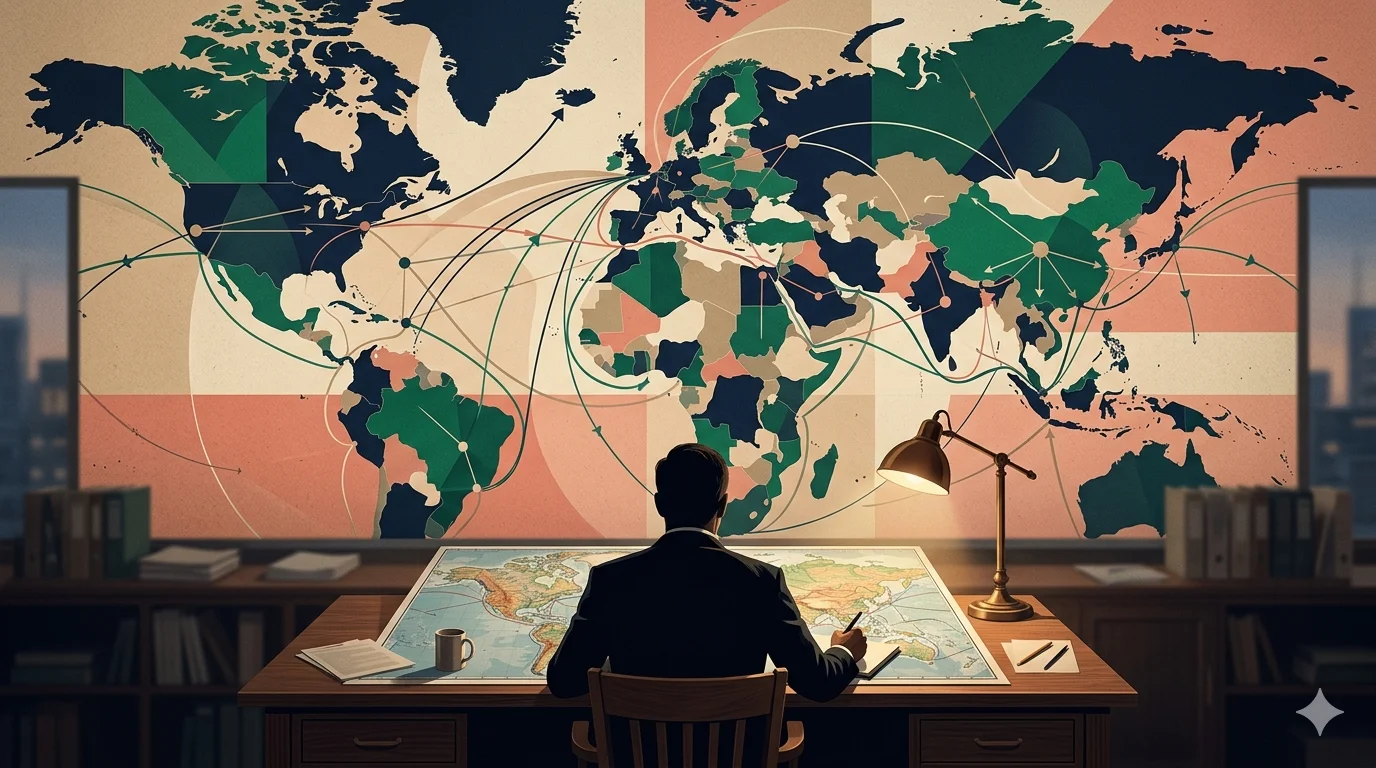
In a recent analysis under the title The new geometry of trade, McKinsey & Company distils what the global economy has shifted away from over the last five years — and what it is shifting toward. This is not a cyclical fluctuation that corrects in the next upswing. It is geometry: where the world’s trade flows actually run, and which routes are wearing out faster or slower than they did last decade.
For Finland, this is a structurally important question. We are an export-driven economy whose jobs, tax revenue and investment outlook depend on how the global trade system is built. When the structure changes, we need to look carefully at the openings it creates — and at the new vulnerabilities it hides.

Source: McKinsey & Company — The new geometry of trade, 13 May 2026
What the structural change is about
Through the mid-2010s the prevailing model of global trade was simple: products were made where it was cheapest — most often China — and shipped to where they were consumed. Supply chains were long, thin and optimised for unit cost. This model worked as long as the assumption held that geopolitics stays in the background and world trade advances on free-trade agreements.
That assumption has broken in the last five years. According to McKinsey’s analysis, global trade is now reshaped by four parallel forces: geopolitical tension between the US and China, climate regulation and the green transition, a reassessment of critical raw materials, and the convergence of labour costs in several formerly low-cost countries. Each alone would be cyclical. Together they form a structural shift.
The name for this shift is a change in the geometry of trade: the map of trade flows is being redrawn. Friend-shoring means production moves to politically trusted partners. Near-shoring means it moves geographically closer to the consumer market. Multi-sourcing means no company any longer relies on a single supplier but builds three parallel ones. Together these trends shorten chains, raise inventories and lift unit costs — in exchange for greater resilience, the ability to withstand disruption.
What the data shows
The numbers confirm the direction, even if the change shows up slowly in any single year’s statistics. China’s share of total US imports has clearly fallen over the last five years, and in the same period Mexico has risen to become its largest goods supplier. The European picture is similar but slower: the EU has tried to reduce its dependence on Chinese supply of critical raw materials and on Russian energy, and behind both shifts lies a structural rather than cyclical logic.
Shorter supply chains also show up in European industrial investment decisions. Battery industry gigafactories increasingly locate in Europe, not in Asia. Pharmaceuticals build European active-ingredient manufacturing capacity that was, in the last decade, mostly shifted to India and China. In semiconductors, the EU Chips Act directs tens of billions of euros to building European fabs, even though the cutting edge remains in US TSMC partnerships and Asia’s existing capacity.
This is more expensive than the old model. The McKinsey report warns that the new geometry of trade lifts prices in those product categories where supply chains have to be rebuilt — and the rise is not temporary. The structural floor of inflation is likely to be a little higher in the next decade than in the last. That is a signal for central bank toolkits as well.
A European perspective — a two-layer response
Europe is in a special position in this shift. On the one hand we lack America’s military and tech-pressure capacity and China’s industrial scale. On the other hand we have a single market of over 400 million consumers, a developed industrial base and global strengths like German machine building that cannot simply be replaced.
The European response should run in two layers. The first is own industrial policy: ReArm Europe-type programmes in defence, the Chips Act in semiconductors, the Critical Raw Materials Act in minerals. These programmes channel public capital where private market activity alone does not produce the necessary capacity, and not quickly enough. The second layer is transatlantic and multilateral coordination: acknowledging that the EU alone cannot replace either the American market or Chinese production, but can build reliable chains together with Canada, South Korea, Japan, Australia and other like-minded countries.
So far especially the second layer has remained insufficiently strengthened. Around Trump’s China visit I wrote earlier in Innohub that Europe is not at the table when the US and China set the rules of the next decade between themselves — but it should be, and it should build its own alliances to do so.
What for Finland
Finland is a trade-dependent small open economy whose export structure, like that of its Nordic peers, is weighted toward intermediate goods, raw materials and high-value-added machinery and process industries. This structure fits those layers of the new trade geometry where reliability and technological specialisation decide — but only if we know how to use our advantage well.
Our strengths are recognisable. Nordic political and contractual stability makes Finland a natural friend-shoring destination for American, Korean and Japanese investors. Green electricity and a highly educated workforce favour the location here of clean battery industry, data centres and demanding process industry. The northern location offers a logistical edge especially toward Northern European and Arctic markets. These are not small things — they are exactly what the new trade geometry rewards.
But we have real vulnerabilities too. We have historically depended on two large neighbouring flows — Germany’s machine building and Northern European trade partnership — and the outlook for both is uncertain in the years ahead. If the German auto industry falls behind in the redefinition of the AI era, the order book of Finnish subcontractors will shrink. If transatlantic tensions sharpen, Finnish companies’ US market access terms could weaken significantly via tariff instruments.
A 2035 perspective
When we look ten years out, the question is no longer whether the new geometry of trade will change the structure of Finnish exports — but how we prepare for it. McKinsey’s analysis offers three guidelines that Finland could adopt as its own policy:
First, active positioning as a friend-shoring destination. This means faster permitting, more predictable taxation and regulation, and targeted incentives for investments that bring high-value-added capacity here. Finland cannot compete with Southern Europe’s cheaper labour, but it can compete on reliability and predictability.
Second, identifying and strengthening our own pieces of the value chain’s leading edge. Finland is traditionally strong in paper machines, lifts, icebreakers, mobile software and AI training capacity. Around these we need to build the kind of ecosystem in which a small country’s strength comes from narrowness and depth, not from breadth. World-class expertise in a narrow area survives the pressure of the new geometry better than broad mediocrity.
**Third**, harnessing our energy asset. Nordic low-emission electricity is one of the largest structural advantages Finland has in this trade geometry. It should be reflected in where electricity-intensive industry’s new investments locate — but only if energy policy stays predictable across electoral terms. I have written earlier in Innohub about why the electoral cycle makes such long-horizon commitments difficult. This is one of the most concrete points where the lack of structural commitment translates directly into the competitiveness of our exports.
Looking ahead
The new geometry of global trade is not a phenomenon of the future that will show up sometime in the 2030s. It is a present phenomenon reshaping supply chains right now. German carmakers are building plants in Texas. American pharmaceuticals are shifting production to Mexico. European battery industry is returning from Asia to its home markets.
For the Finnish decision-maker the question is not whether to receive the change. It is whether to receive it leaning forward or leaning back. Received leaning forward, it is one of the most significant growth opportunities of the next decade for Finland — a reliable northern small country whose strength is predictability, technical precision and low-emission energy. Received leaning back, it is a slow adaptation to a shrinking export market.
The answer does not need to be ready immediately. But the question needs to be on the next government’s first three-month agenda — not its last.

Continue reading
You may also like


Innohub TV
Watch this content also on Innohub TV
We picked clips from Innohub TV that continue the same topic.
