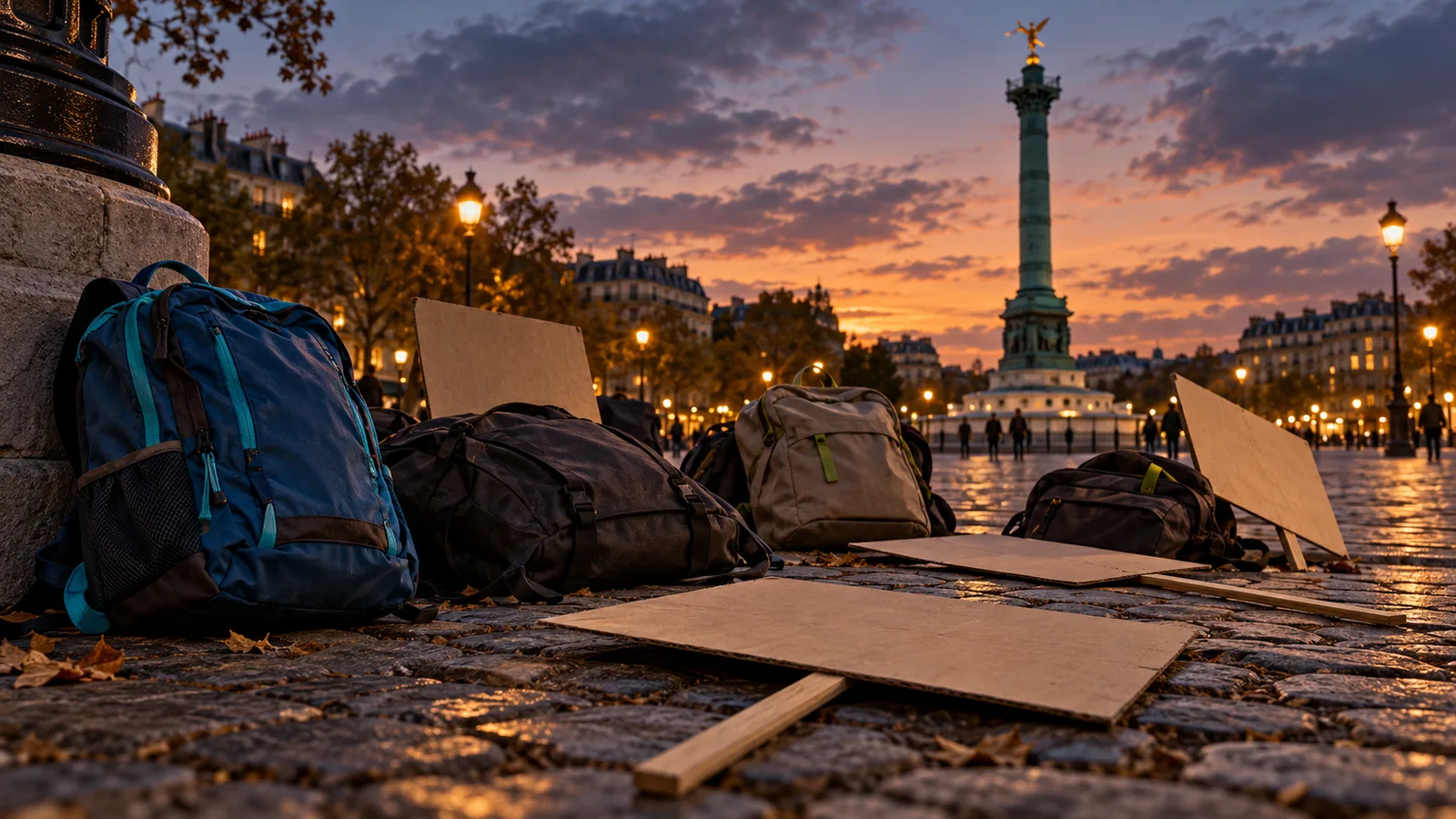
Burned schools, looted shops and curfews are not protest but destruction, and the bill lands on pupils, police officers and businesses – from the corner shop to the big retail chains. France must reform its public sector, with the help of artificial intelligence and with courage.
The romantic streets of Paris, which so many visitors remember as a city of cafés, bookshops and evening walks, have looked like a war zone this autumn. Schools have been set on fire and looted, shop windows smashed and cars torched, and some 760 police officers have been injured. According to the French Ministry of Justice, 6,877 arrests had been made by 9 October, and 86 per cent of them involved minors. This cannot be called a demonstration. Burning a school does not repair a single classroom; it takes teaching away from the very young people in whose name the streets are being wrecked. Violence and destruction must be condemned clearly, with no “but” attached.
The movement began in mid-September in schools in the Paris suburbs, and its original demands were down to earth: smaller classes, buildings in decent repair and a teacher who actually shows up. Those demands could have been made peacefully, and many people did make them that way. In early October, however, things escalated. On 8 October students climbed the column on Place de la Bastille, and the left-wing politician Jean-Luc Mélenchon proclaimed the Bastille retaken. Revolutionary romanticism is dangerous fuel when minors are out on the streets. Some twenty cases of police use of force are under investigation, in one of which a 15-year-old lost a hand, and they must be examined thoroughly, because a state under the rule of law is also judged by how it polices its own use of force. None of this changes the fundamental point: order must be restored.
The movement has spread to Belgium and Italy, and on 17 October people also took to French streets to protest against the cost of living and fuel prices, in scenes reminiscent of the yellow-vest era. Over the weekend of 18–19 October several cities imposed curfews. This is where the bill passes to businesses that did nothing to cause the situation. When a neighbourhood is shut down for the evening, the café loses its evening takings, the restaurant throws its ingredients away, the corner shop cashes up an empty till and the hair salon cancels its clients. Rent, wages and loan repayments do not bend. The same goes for the big players: retail chains and department stores close early, board up their windows, hire extra security and move their staff out of harm’s way, while shopping centres lose their evening trade altogether. Looting and vandalism will soon show up in insurance premiums across the entire retail sector. The parallel with the Covid restrictions is impossible to miss. Back then businesses bore a disproportionate share of the cost of shutting society down – smaller firms often to the point of bankruptcy, the big chains through furloughs and closed stores – and many never got back on their feet. Now the same thing is happening without a virus: trade grinds to a halt because the streets are not safe. That is why a cash buffer of your own is an entrepreneur’s first line of insurance, even in Europe’s most stable countries.
The hardest question is also the simplest: what have these businesses done wrong? Videos shared from the streets show young people smashing the windows of small clothing boutiques and chain stores alike and carrying goods off the shelves. A shop built over years of work loses its window display, its stock and at least the amount of its insurance excess in a single evening, and no policy can restore lost confidence in the safety of the street. A looted chain store means sales staff dreading their next shift, shuttered branches and costs that end up in prices for every consumer. Not one of these businesses decides class sizes or the condition of school buildings. They carry one of the heaviest tax and social-charge burdens in Europe, which funds the very schools the marchers claim to be fighting for. The damage is therefore twofold: first a business funds the system through its taxes, and then it pays for the system’s failure with its broken windows. If the revolt has a message, it should be addressed to the people in power, not to the shops.
Behind it all lies a structure that explains the frustration but does not justify the violence. According to INSEE, France’s national statistics office, public spending last year came to around 57 per cent of GDP, the general government deficit to around 5 per cent and debt to around 116 per cent. Some 5.9 million people work in the public sector, roughly one in five of everyone in employment. Yet unemployment has risen to around 8 per cent, its highest level in years, and around 21 per cent of 15–24-year-olds are out of work. France is short of neither public money nor public employees. What it lacks is efficiency: the money stays in administrative structures and never reaches the suburban classroom or a young person’s first job. Prime Minister Sébastien Lecornu’s minority government has promised around 3,000 substitute teachers, the right gesture but not a structural change, and the presidential election of April 2027 makes major reforms difficult precisely when they are most needed.
An even tougher transition lies ahead for France. As the country puts artificial intelligence to more effective use and cuts back on office work in the public sector, unemployment is likely to rise before it starts to fall. Processing official forms, compiling reports and preparing routine decisions is exactly the kind of work AI does faster and more cheaply. There is no point in dressing that up in fine words. At the same time it is an opportunity France has failed to seize for decades: once administrative paperwork is automated, money and people are freed up for the places where no machine replaces anyone. France could hire more teachers, reduce class sizes and invest in vocational training without adding further to its debt. Shifting resources from administration to the classroom is exactly the reform the schools are calling for, but it will come from decisions, not from barricades.
The same technology is also a tool for business. The AI boom is not a game reserved for big corporations: an AI assistant can handle a one-person company’s customer service, bookkeeping groundwork and marketing for a price that only a few years ago would have meant hiring an employee. For the rest of Europe, the unrest in France is a warning. A stable, predictable EU that keeps its public finances in order is the best protection businesses have, because investment and customers go where next week looks like this one. Smaller firms in particular should do three things now. First, keep the business lean enough that changing course is possible when the market or the security situation shifts. Second, adopt AI in a way that keeps trust and speed moving in the same direction. And third, prepare for disruption: a cash buffer, online sales and an operating model that can survive a few closed evenings without going under. An entrepreneur cannot choose whether the cars on the next street go up in flames, but they can choose whether their business is built to withstand it.

Burning a school does not repair a single classroom; it takes teaching away from the very young people in whose name the streets are being wrecked.
First a business funds the system through its taxes, and then it pays for the system’s failure with its broken windows.
Shifting resources from administration to the classroom is exactly the reform the schools are calling for, but it will come from decisions, not from barricades.
Sources
- Euronews – Teen revolt or revolution? The student protests threatening France’s presidential race (11 October 2026)
- INSEE – French National Institute of Statistics and Economic Studies — Public spending, deficit, debt, public-sector employment and unemployment figures
- Students face riot police as protests over school conditions escalate in France • FRANCE 24

Continue reading
You may also like


Innohub TV
Watch this content also on Innohub TV
We picked clips from Innohub TV that continue the same topic.