

On a panel at Startup Grind’s Global Conference, a question is opened that has bypassed many Finnish B2B founders in recent months: why do most AI tools companies evaluate never reach production use? Pilots go well. Demos convince. The procurement lead writes a thank-you note. Then come four months of silence — and the tool is nowhere.
This is not a random phenomenon. It is structural, and understanding it is one of this year’s most important learning topics for the Finnish B2B founder. If you are building an AI product for enterprise sales, you need to understand why 80–90% of post-pilot decisions end in a “not now” answer. And above all, you need to know what that means for your sales strategy.
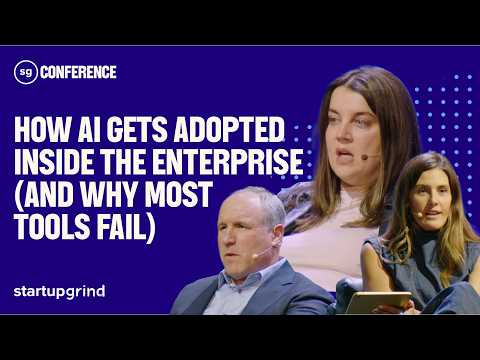
Source: Startup Grind — How AI Gets Adopted Inside the Enterprise, 5 May 2026
What it’s about — three reasons AI tools stay stuck in pilot
In the middle of the panel three structural reasons rise as to why AI tools’ enterprise sales stumble exactly between pilot and production use. These are the same three reasons by which the Finnish B2B founder can recognise their own situation if the sales cycle has felt longer than expected.
The first is integration cost. An AI tool is rarely a standalone product. It needs to read something from the customer’s system — CRM data, contract archive, accounting system, intranet, emails, customer contracts, process descriptions — and from that reading is born work that does not belong to the tool’s vendor. The procurement decision lets the tool in, but after that IT does an assessment of what it requires of internal staff time. That assessment is almost always larger than the seller had proposed. The customer decides the timing isn’t right.
The second is trust in data security. The AI model is often a third-party service (OpenAI, Anthropic, Google), and the enterprise customer does not want to give its own confidential data to an unfamiliar stack. Even if contracts state the data is not used for training, the procurement process still requires a security review that lengthens the cycle by months. A small vendor finds it harder to clear this review as convincingly as Microsoft’s or Salesforce’s built-in AI function.
The third is change management. Even if the technology works, taking the AI tool into use requires employees to work in a new way. This is a change-management question that in most enterprise organisations belongs to HR, training and internal communications — not IT. So when the tool vendor has promised “a week’s deployment”, reality is often half a year of internal work the vendor does not see — and therefore does not propose alongside the pilot.
What this teaches the Finnish B2B founder
These three reasons are not random problems. They are the structure of enterprise sales that applies to American as well as Finnish sales chains. But the Finnish founder has a few special traits worth raising.
The first is that the Finnish enterprise customer is structurally more cautious than the American. This is not a weakness — it is a cultural trait that is part of the Nordic operating environment’s reliability. But it means the post-pilot decision requires more burden of proof than in an American environment. The Finnish B2B founder must accept the sales cycle is often 12–18 months, not 3–6.
**The second is that the Finnish customer values data security and data locality more than many others.** This is a structural sales edge if you know how to use it. EU-based data centres, DPF/GDPR-compatible architecture and European hosting options are real sales arguments to a Finnish customer that an American competitor cannot offer with the same credibility. I have written earlier in Innohub about how the new trade geometry favours European supply chains — the same logic applies to the data chain.
The third is that offering change-management support as part of the product separates good vendors from mediocre ones. A Finnish growth company can do this better than the American competitor, because a smaller company can offer more personal support. This is a costly investment in the early stage but pays back many times over through the customer lifetime.
Concrete structural choices
The panel’s message is worth turning into concrete structural choices. If you are building an AI tool for enterprise sales, three things are worth weighing before the first big pilot.
First, design the product structurally around integration cost. If your product requires six weeks of the customer’s IT work before it functions, your sales cycle is six months longer than it should be. Design the product so that its first working version is in use in a week — even if it does not yet use all features. This is a shift from classic enterprise product development, where “full integration” was the measure of value. Now the value measure is “fast deployment, deepening integration”.
Second, build security into a sales argument, not just a mandatory requirement. Active security talk — that is, the vendor themselves raising how they handle the customer’s data, where it resides, who has access — reduces the customer’s need to have the same conversation on every round of the procurement process. This shortens the cycle and gives an image of a trustworthy vendor that lasts to the decision. For a European vendor this is, in practice, a free differentiator.
**Third, include change-management support in the offer.** This is a structural sales decision. You can price the change-management support separately, include it in the licence fee, or give it free for the first year. Regardless of pricing, offering it separately is a signal to the customer that you understand their real cost. I have written earlier in Innohub that the B2B customer chooses the one that looks best to sustain their own organisation’s needs over the next three years — change-management support is part of that promise.
A Finnish sales pitfall
There is one more point worth raising for the Finnish B2B founder. We tend to undervalue the importance of sales relative to the product’s technical merit. “The product sells itself if it’s good enough” — this is a common but dangerous assumption. In enterprise sales the product does not sell itself. The seller who understands the customer organisation’s internal dynamics sells the product.
This means the Finnish AI startup should invest in the enterprise sales team as much as in product development. A single senior seller who knows the Finnish or Nordic procurement process from inside is often more valuable than four junior developers. This is an uncomfortable decision for a small company whose capital is limited, but it is structurally right. I have written earlier in Innohub that in B2B sales reducing risk is more important than lowering the price — investing in sales is part of that very risk reduction from the customer’s perspective.
What to take away
The Startup Grind panel is 25 minutes long and worth watching in full if you are building an AI product for enterprise sales. But its message fits into three guidelines for the Finnish B2B founder:
- Design the product structurally for fast first deployment, not perfect integration. The customer wants to see benefit in a week, not a month. Deepening integration can come later.
- Make data security and change management active sales arguments. For European customers these are structurally more important than for Americans — use your advantage.
- Invest in enterprise sales as much as in product development. A senior seller who knows the customer organisation from inside is often more valuable than another product feature.
The AI era brings new opportunities to enterprise sales — but also new obstacles. The Finnish founder who understands both opportunities and obstacles builds a product that does not get stuck in pilot. And that is the core of building a B2B growth company.

Continue reading
You may also like


Innohub TV
Watch this content also on Innohub TV
We picked clips from Innohub TV that continue the same topic.