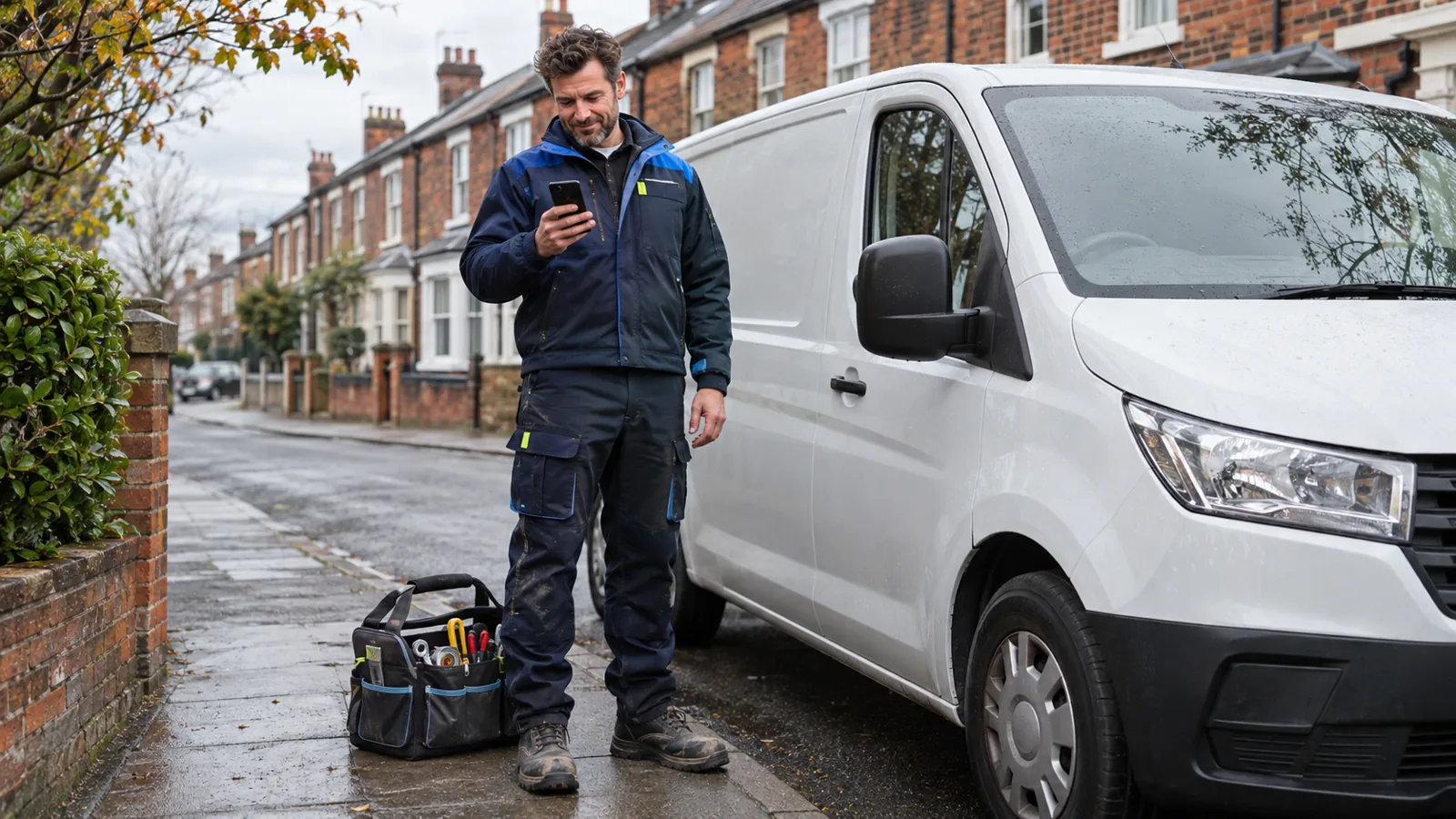
The phone rings while you are under a sink or up a ladder. By the time you call back, the homeowner has booked someone else. The question is what that actually costs you.
The short answer: there is no trustworthy national figure. The “X% of callers never ring back” statistics that circulate online usually trace back to companies selling answering services, not to published research. What you can do is calculate your own number from your call log, your win rate and your margin. It takes about ten minutes, and the result tells you how much it is worth spending to answer more calls.
Why this hits trades harder than most
According to the Department for Business and Trade’s Business population estimates 2025, there were about 5.7 million private sector businesses in the UK at the start of 2025. Three quarters of them (4.3 million) employed nobody apart from the owners. Construction had the largest number of SMEs of any sector: 885,000, or 16% of the total.
In most trades businesses, the person answering the phone is the person doing the work, with no office to catch the call. That is why missed calls pile up, and why fixing them is often the cheapest growth you can buy.
Step 1: count missed enquiries, not missed rings
Your phone’s call history is a starting point, not a sales report. Strip out:
- suppliers, merchants and other trades;
- existing customers checking arrival times or chasing invoices;
- repeat attempts from the same number (three missed calls from one homeowner are one enquiry);
- spam and sales calls;
- enquiries for work you don’t do or outside your area.
What is left is the figure that matters: unique new enquiries for work you could have taken. Then note which of those you reached on a callback and which you never converted.
A spreadsheet is enough to start. If handovers between several people get messy, compare options in the Innohub CRM directory.
Step 2: put a value on the enquiries you lose
The formula is simple:
Monthly profit at risk = unrecovered new enquiries × your normal win rate × average contribution per job
- Unrecovered new enquiries: qualified callers you missed and never booked, even after a callback.
- Win rate: the share of answered enquiries of the same kind that normally turn into a job. Use your own records, not a vendor’s claim.
- Contribution per job: the job price minus materials, extra labour, travel and other costs you only incur because of that job.
A worked example (hypothetical figures)
Take an imaginary plumbing and heating firm with these numbers for one month. They are illustrative, not industry benchmarks:
- 40 missed calls in the phone log.
- After removing suppliers, customers, repeats and spam, 12 are new enquiries for work the firm does.
- Callbacks reach and book 5 of them, leaving 7 unrecovered.
- The firm normally wins 40% of comparable answered enquiries.
- The average job is £450 excluding VAT, with £230 of materials and travel, so contribution is £220.
7 × 0.40 × £220 = £616 a month, or about £7,400 a year.
Now run a cautious and an optimistic version. At a 25% win rate and £180 contribution, the figure falls to £315 a month. At 50% and £260, it rises to £910. Keep all three numbers visible. If even the cautious figure is higher than the cost of better call handling, the decision is easy.
Capacity changes the answer
If you are fully booked for six weeks, a recovered enquiry may only fill a cancellation or let you be choosier about jobs. That has value, but it is not new profit.
Invoice value is not profit
A lost £450 job is not a £450 loss. Use the Innohub margin calculator to work out contribution, and the hourly rate calculator to check what your time is worth on labour-heavy jobs.
Keep VAT consistent. You must register for VAT once your taxable turnover over the last 12 months goes over £90,000. If you are registered, use VAT-exclusive figures on both the price and the cost side, and keep the records HMRC requires. Comparing a VAT-inclusive invoice with a VAT-exclusive materials bill makes your margin look bigger than it is.
Fix the free things first
Before paying for any service, look at when the lost enquiries arrive. While you are on site? After 5pm? During the school run? The answer decides the fix. Then:
- Rewrite the voicemail greeting. Give the business name, ask for a name, postcode and a brief description of the job, and say when you will call back. Only promise what you can keep.
- Give callbacks one owner. “Whoever is free” means nobody. Name the person who checks missed calls and who covers when they are off.
- Call back the same working day. Speed matters most for urgent work such as leaks and breakdowns.
- Send a text when you can’t answer. Many phone systems can automatically send a short reply to missed callers, so they know you will get back to them.
Shared cover, answering services or AI?
Once the free fixes are in place and your log still shows a gap, you have three main options.
Shared cover. A partner or office assistant takes calls. Cheap, but count their time too.
A human answering service. Operators take messages or book jobs on your behalf. This suits callers who need reassurance or jobs that need judgement. Ask how operators learn your services and area, how urgent messages reach you and what the full charging basis is, including out-of-hours calls.
An AI receptionist. AI call handling has improved quickly. A good system now answers instantly at any hour, takes accurate details, answers routine questions and can book straightforward jobs into your calendar. It costs far less than a person. Its limits are just as important. It should never invent a price, confirm a booking it can’t honour or give safety advice. Our article on what breaks in voice agents after the demo covers the failure points to test, and where to set the handover between AI and people explains how to draw the line.
Test the awkward calls
Test it the way real customers will use it: a noisy line, an unusual street name, a caller who changes their mind and a genuine emergency. Then check what reaches your phone. The test is simple: can you turn up at the right address, ready for the right job, without ringing the customer again?
Call logs, recordings and UK GDPR
A missed-call log contains names and phone numbers, so it is personal data. Keep it lean: enough to reconnect with the caller and record the outcome, nothing more.
Recording or transcribing calls goes further. Under UK GDPR you need a lawful basis. The ICO’s guidance on legitimate interests uses the example of a company recording helpline calls for staff training. The ICO points out that callers are more likely to expect processing if you explain it clearly upfront. A line buried in a long privacy policy is unlikely to do that. In practice, a short spoken notice at the start of the call plus a plain-English privacy page goes a long way.
If an AI or answering provider handles calls for you, check where the recordings and transcripts are stored and who can access them. UK GDPR closely mirrors the EU’s GDPR, so providers that already meet EU standards are usually a sound starting point.
Measure whether it worked
Compare like with like: the same months, similar advertising, similar availability. Track recovered enquiries, completed jobs, contribution and the full cost of the service, including its mistakes. The season or an extra pair of hands can also lift bookings, so keep the arrangement only if the numbers support it.
Video: building a call flow that catches every call

Source: Housecall Pro, How to Never Miss Another Call to Your Home Service Business (how-to), November 2026.
This is a product walkthrough from a US field service software company, so the tools and prices are not UK-specific. The useful idea transfers anywhere: a call flow that rings the office first, then the people in the field, and only then passes unanswered or after-hours calls to an AI assistant instead of voicemail. Watch it for the logic of ring order and handover, then sketch the same flow for your own business.
Whichever provider you choose, test it on your own awkward calls before you rely on it.
Frequently asked questions
How much does one missed call cost a UK trades business?
It depends on your own figures, so no national average is worth quoting. Multiply the new enquiries you never recover by the share you would normally win and by your average profit per job after materials and travel. In our worked example that comes to roughly £600 a month, but your number could be far higher or lower.
Should I use the full job price in the calculation?
No. Use contribution, which is the job price minus materials, extra labour, travel and other job-specific costs. The invoice total overstates what you lose. If you are VAT-registered, keep every figure excluding VAT.
Does every missed call mean a lost customer?
No. Suppliers, existing customers and repeat attempts from the same person all show up as missed calls. Many new callers also pick up when you ring back. Count only unique new enquiries for work you do, and only the ones a callback failed to recover.
Is an AI receptionist better than a human answering service?
For taking details, answering routine questions and booking simple jobs out of hours, AI services are now good and usually cheaper. For anxious customers, complicated jobs or anything involving safety advice, a person is still the safer choice. Many firms combine both and test them on awkward real-world calls.
Do I have to record calls to measure missed enquiries?
No. A simple log of time, reason for calling, outcome and callback is enough. If you do record or transcribe calls, UK GDPR applies. You need a lawful basis and must tell callers clearly and upfront.
What should I fix first?
Rewrite your voicemail greeting, give one named person ownership of callbacks and ring every new enquiry back the same working day. These cost nothing. Pay for extra cover only once your log shows when and where enquiries are being lost.

Continue reading
You may also like




Innohub TV
Watch this content also on Innohub TV
We picked clips from Innohub TV that continue the same topic.