
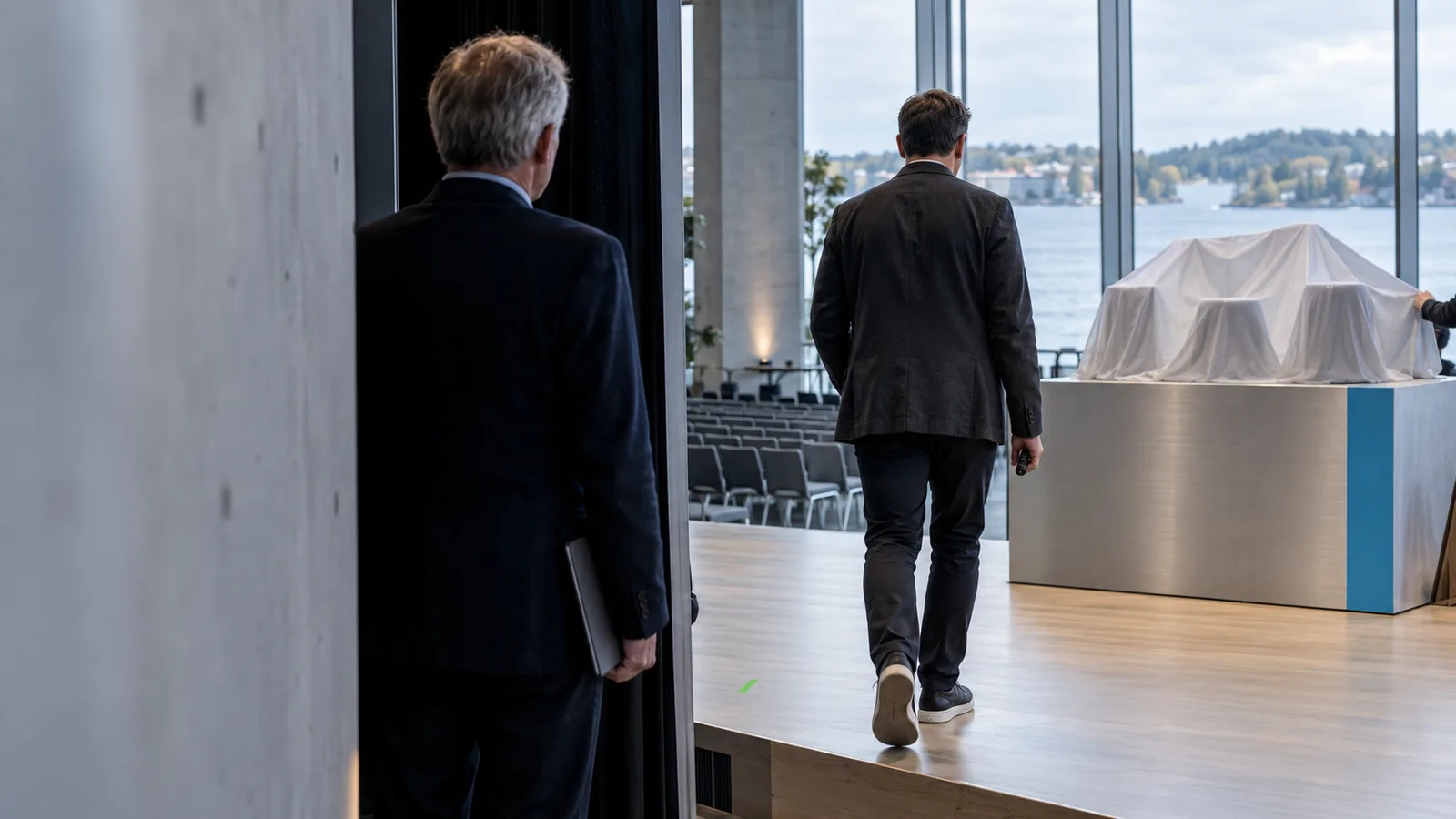
Apple's leadership handover is a test of authority, software ambition and strategic patience.
John Ternus has taken the Apple CEO role with almost no runway. As TechCrunch’s Equity episode frames it, Tim Cook stepped down just before a major product moment, while Ternus’s first memo promised a “huge launch next week.” The John Ternus era therefore begins under stage lights, not behind the closed doors of a long strategy retreat.
That timing makes the transition unusually revealing. A polished launch can show continuity, but it cannot prove what the new leader will change. For founders and executives, the richer question is how a company transfers authority while the outgoing chief stays close, the incoming chief inherits a full calendar, and AI changes what customers expect.
A succession that starts in public
Ternus’s first major event will largely reflect work set in motion before he became CEO. That is normal in a large company, yet it creates a tricky narrative: the new leader is visible immediately, while his own strategic fingerprints may take much longer to appear. Shareholders still want clues now.
The useful question is not whether Ternus can claim the next launch as his own. It is whether he can use an inherited moment to establish a decision-making rhythm: what receives attention, which trade-offs are named, and where the company sounds newly decisive.
The title changes faster than the operating system
Every handover contains two clocks. The public clock starts on announcement day; the operating clock moves through product road maps, budgets, hiring and internal relationships. Trouble begins when stakeholders judge the second by the speed of the first.
This matters beyond Apple. A founder moving into an executive-chair role, or an owner handing daily control to a successor, faces the same structural question. As our analysis of how founder, product and governance risk become entangled shows, ambiguity at the top can quickly travel into product choices.
A handover is not complete when the title changes. It is complete when everyone knows where the final decision now sits.
Why software may define a hardware leader
Ternus arrives from hardware, which makes the obvious expectation simple: protect Apple’s product discipline and keep the launch machine moving. Yet the Equity hosts raise a more surprising possibility in the discussion beginning at 1:12: he may be better positioned to make progress in software than in hardware during this AI era.
That idea deserves attention. Hardware expertise is partly the discipline of making thousands of dependencies work as one customer experience. AI products need a similar instinct because the model is only one layer; interfaces, reliability, privacy choices and everyday workflows determine whether people find the result useful.
For a smaller company, this is a welcome reminder that AI strategy does not begin with chasing the most impressive demo. It begins by finding a customer task where software can remove friction without creating new confusion. The same principle sits behind these workflow lessons beyond the AI hype: value appears when a tool fits real work, not when it merely looks intelligent onstage.
The leader’s background is a starting point
The best succession choice is not always the person whose résumé matches yesterday’s biggest problem. It may be the leader whose habits transfer well to tomorrow’s bottleneck. Ternus must show whether hardware discipline can become software momentum without weakening the strengths he inherits.
The most revealing question of the Ternus era may be whether a hardware leader can make software feel urgent.
Tim Cook’s new role is part of the strategy
Cook is not disappearing. He is staying as executive chairman and, according to the episode, will focus on policy relationships—the kind of work that recently turned something as small as a map label into a public balancing act. That gives Apple continuity where relationships and institutional memory matter.
It also creates a boundary that must be actively managed. An experienced predecessor can protect the new CEO from avoidable distractions, but employees, partners and investors still need to know who decides what. Otherwise, every difficult call can become a quiet referendum on who truly leads.
The policy focus is also a signal to companies far smaller than Apple. Product decisions now cross borders, public expectations and government relationships with surprising speed. We have argued that geopolitical risk is a business variable; Cook’s continuing brief shows how close that variable can sit to the product itself.
The market will measure pace, not biography
The Equity episode asks how much rope shareholders will give Ternus. That is the right question, but patience is rarely measured in months alone. Investors watch for evidence that a leader understands the real constraint and can build a credible sequence of decisions around it.
The wider episode places Apple’s transition beside Nvidia’s expanding AI bets, a busy week in robotaxis, new “machine age” capital from a16z, and GoPro’s pivot toward AI and defense. The comparison sharpens the pressure: Apple is changing leaders while adjacent industries are already reallocating attention.
Ternus does not need to reinvent Apple in his first week. He does need to make the handover feel purposeful. In any company, timing a strategic change in the AI age requires a clear view of what should continue, what should stop and which uncertainty deserves an experiment rather than another memo.
What founders can learn from the Ternus transition
Apple’s scale is exceptional, but the leadership mechanics are familiar. A successor inherits commitments, a predecessor retains influence, customers expect delivery, and the market interprets every visible move. Four principles travel well from Cupertino to a growing company:
- Define decision rights early. If the former CEO stays involved, document which relationships and decisions remain with that person and which belong fully to the successor.
- Separate inherited delivery from new strategy. A successful launch proves execution; it does not automatically prove that the next chapter has a direction.
- Match leadership habits to the next bottleneck. Functional background matters less than the ability to transfer discipline into the area where progress is hardest.
- Set evidence, not theatre. Choose a few observable signs of progress so employees and investors do not mistake constant announcements for strategic movement.
The biggest opportunity in the John Ternus era is not a dramatic break with everything Tim Cook built. It is a clear transfer of authority paired with enough continuity to keep the company moving. That difficult balance is what good succession looks like: the machine keeps running while a new driver begins choosing the road.

Sources
- What will Apple's John Ternus era look like? | Equity Podcast — TechCrunch Equity Podcast episode published September 4, 2026. Primary source; the Apple leadership segment begins at 1:12.

Continue reading
You may also like




Innohub TV
Watch this content also on Innohub TV
We picked clips from Innohub TV that continue the same topic.
