

Tiivistetty vastaus: {{INNOHUB_IMAGE:ai-governance–1.jpeg}} AI Governance tarkoittaa tekoälyn johtamista, sääntöjä, vastuita ja valvontaa organisaatiossa.
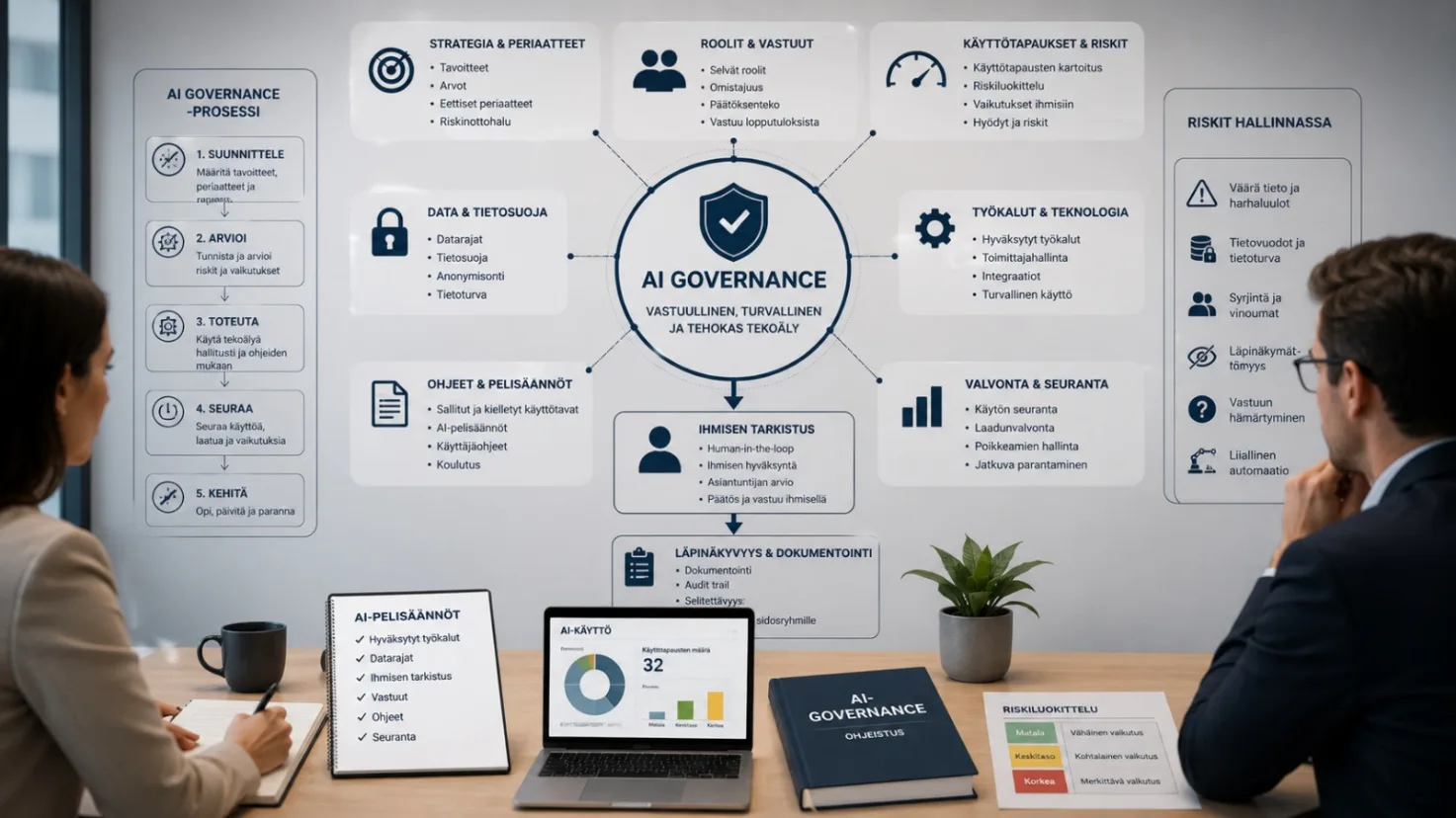
AI Governance means the management, rules, responsibilities, and oversight of AI within an organization. It answers the question: who may use AI, for what purpose, with what data, with which tools, and who is accountable for the results? Good governance isn't just bureaucracy — it makes AI use safer, more effective, and more scalable. Without shared ground rules, every team may use AI differently, and then risks, costs, and quality can easily spiral out of control.
Käytännön vinkki: Laadi organisaatiolle AI-pelisäännöt: hyväksytyt työkalut, sallitut ja kielletyt käyttötapaukset, tietosuojarajat, vastuuhenkilöt, tarkistusprosessi ja ohjeet siihen, milloin ihmisen pitää hyväksyä AI:n tuottama sisältö.
Intro
AI Governance — the good governance of AI that separates experimentation from lasting competitive advantage
AI Governance is not a brake on AI. It is a steering wheel, a seat belt and a map in one package — without it, an organization can move fast but does not know who is at the wheel when the road gets slippery.
1. Introduction: AI needs leadership, not just users
In many organizations, AI is already part of everyday work, even if it is not yet officially managed.
Yksi tiimi käyttää ChatGPT:tä asiakasviestien luonnosteluun. Toinen kokeilee tekoälyä rekrytoinnissa. Kolmas syöttää myyntidataa analyysityökaluun. Neljäs rakentaa automaatiota, joka tekee päätösehdotuksia ilman, että kukaan on täysin varma, mihin data menee tai kuka vastaa lopputuloksesta.
Tämä on tekoälyajan tuttu välivaihe: käyttö leviää nopeammin kuin hallinta.
At first it feels efficient. People save time, get better drafts and discover new ways of working. But without shared ground rules, that same speed can turn into risk.
That is when the questions start piling up:
- Can customer data be entered into an external AI tool?
- Who approves AI-generated content?
- Which use cases must not be automated?
- How do we make sure AI does not discriminate, leak information or draw incorrect conclusions?
- Who is responsible if an AI suggestion leads to a wrong decision?
Näihin kysymyksiin vastaa AI Governance eli tekoälyn hyvä hallintotapa.
It is not mere bureaucracy. At its best, it is the organization's way of making AI safe, effective and scalable.
EU:n AI Act on maailman ensimmäinen kattava tekoälyn oikeudellinen kehys, ja sen tavoitteena on edistää luotettavaa tekoälyä Euroopassa riskiperusteisen sääntelyn avulla.[1]
2. What does AI Governance mean?
AI Governance means the leadership, rules, responsibilities and oversight of AI within an organization. Put more simply, it answers the question:
Who may use AI, for what purpose, with what data, with which tools — and who is responsible for the outcomes?
That sounds administrative. But in practice it is about everyday decisions. For example:
- May an employee use AI to summarize a customer document?
- May the sales team feed CRM data to AI?
- May HR use an AI tool to pre-screen applications?
- May a customer service bot make refund decisions?
- May AI suggest a diagnosis, a contract clause or a credit decision?
- At what point does a human need to check the AI's output?
Hyvä AI Governance tekee nämä rajat näkyviksi. Ilman sitä tekoälyn käyttö perustuu helposti yksittäisten ihmisten omaan harkintaan. Se voi toimia pienessä kokeilussa, mutta ei enää silloin, kun tekoäly leviää koko organisaatioon.
3. Why has AI governance become critical right now?
AI is no longer just an IT department project. It is used by marketing, sales, customer service, HR, finance, product development, leadership, lawyers and analysts. That makes AI an exceptional technology: it does not stay in one system but quickly seeps into every layer of work.
Traditional software usually does what it was built to do. AI, by contrast, produces answers, assessments, recommendations and drafts depending on the situation. It can sound confident even when it is wrong.
AI brings at least four new challenges to an organization:
- Käyttö leviää hajautetusti. Työntekijät voivat ottaa käyttöön työkaluja ilman keskitettyä päätöstä.
- Data liikkuu uusiin paikkoihin. Promptiin voi päätyä asiakasdataa, henkilötietoja, sopimuksia tai liikesalaisuuksia.
- Laatu vaihtelee. AI:n tuotos voi olla erinomainen, keskinkertainen tai virheellinen — usein hyvin vakuuttavassa muodossa.
- Vastuu hämärtyy. Jos tekoäly ehdottaa ja ihminen hyväksyy, kuka oikeasti vastaa?
NISTin AI Risk Management Framework on kehitetty auttamaan organisaatioita hallitsemaan tekoälyn riskejä yksilöille, organisaatioille ja yhteiskunnalle.[2]
Tämä on hyvä tapa ajatella AI Governancea: kyse ei ole vain sääntöjen tekemisestä, vaan riskien ymmärtämisestä ja hallinnasta.
4. The basic questions of AI Governance
1. What AI do we use?
Many organizations do not know. They may be using public AI services, enterprise AI tools, AI features built into the CRM or HR system, their own machine learning models, automations and agents that can use tools and carry out multistep tasks.
Ensimmäinen hallinnan askel on inventaario: mitä AI-järjestelmiä ja käyttötapauksia organisaatiossa oikeasti on?
2. What may AI be used for?
Not all uses are equal. Asking AI to brainstorm blog headlines is one thing; letting it score job applicants or propose a loan decision is quite another.
Good governance divides use cases into, for example, three groups: permitted; permitted under certain conditions; and prohibited or requiring separate approval.
3. What data may be given to AI?
This is one of the most important questions. The organization has to define whether AI may be given public information, internal information, customer data, personal data, sensitive personal data, trade secrets, contracts, source code or financial data.
Jos tätä ei määritellä, työntekijät joutuvat arvaamaan. Ja arvaaminen on huono tietosuojastrategia.
4. Who is responsible for the outcome?
AI does not carry responsibility. The organization and its people do. That is why every significant AI use case needs a named owner. Not an abstract “the business.” Not a vague “IT.” But clearly: who is responsible for quality, risk, oversight and decisions?
5. The anatomy of good governance: people, processes, tools and responsibilities
AI Governance is not a single document. It is a whole in which four elements work together.
People
You need roles: a business owner, a technical owner, a data protection officer, a security officer, a legal expert, risk management, users and leadership.
Pienessä startupissa nämä roolit voivat olla samoilla ihmisillä. Isossa organisaatiossa ne jakautuvat eri tiimeihin. Oleellista ei ole organisaatiokaavio, vaan se, että vastuut ovat selvät.
Processes
You need ways of working: how a new AI use case is approved, how risks are assessed, how data is checked, how AI output is validated, how errors are reported and how use cases are monitored over time.
Without a process, AI Governance remains a guideline on the intranet.
Tools
You need approved tools and technical limits. For example: which AI services are permitted, whether enterprise agreements are used, whether entered data is stored for model training, how logs are collected, how access rights are managed and how sensitive data is prevented from ending up in the wrong places.
Responsibilities
If an AI system makes a mistake, you need to know who notices it, who stops its use, who fixes the process, who communicates with customers or authorities and who decides whether to continue using it.
Good governance does not eliminate errors entirely. It makes them manageable.
6. AI ground rules in the organization
Every organization needs AI ground rules. Not an 80-page document nobody reads. But clear guidance that says what you may and may not do.
1. Approved tools
Employees need to know which tools they may use: approved general AI tools, approved enterprise tools, prohibited or unapproved tools, and guidance on browser extensions and unofficial apps.
2. Permitted use cases
For example: drafting text, summarizing internal documents if the data allows it, brainstorming, drafting translations, explaining code, and classifying customer feedback if data protection has been taken into account.
3. Prohibited or approval-required use cases
For example: processing personal data without approval, entering sensitive information into public tools, automated recruiting decisions, legal/medical/financial decisions without expert review, and customer-facing content in high-risk areas without human approval.
4. Data protection boundaries
This needs to be stated plainly. What data may be used? What may not be used? When does data need to be anonymized? When must only an approved enterprise environment be used?
5. Human approval
It is worth writing a clear human-in-the-loop principle into the ground rules:
AI may prepare a proposal, but a human approves the result before external use or any significant decision.
6. Error reporting
Työntekijöiden pitää tietää, mitä tehdä, jos AI antaa vaarallisen vastauksen, paljastaa väärää tietoa, tekee syrjivän ehdotuksen, käyttää väärää dataa tai tuottaa asiakkaalle haitallisen sisällön. Hyvä kulttuuri tekee virheiden ilmoittamisesta helppoa, ei noloa.
7. Risk-based thinking: not all AI use is equal
One of the most common mistakes in AI Governance is treating all AI use the same way. That leads to a model that is either too lax or too heavy. If everything is allowed, risks spiral out of control. If everything requires heavy approval, nobody bothers to use AI sensibly.
Low risk
Examples: internal brainstorming, headline options, summarizing general text without confidential data, drafting training material.
Governance model: light guidelines, users' own review, no sensitive data.
Medium risk
Examples: drafts of customer messages, internal analyses, sales materials, classifying customer feedback.
Governance model: approved tools, human review before external use, clear data boundaries.
High risk
Examples: recruiting, credit decisions, health-related recommendations, insurance decisions, legal interpretations, HR decisions.
Governance model: separate approval, a documented risk assessment, human-in-the-loop, monitoring and auditing, clear responsibilities.
EU:n AI Act asettaa korkean riskin tekoälyjärjestelmille velvoitteita muun muassa riskienhallintaan, dokumentointiin, ihmisen valvontaan ja käyttöohjeiden noudattamiseen. Korkean riskin järjestelmien käyttäjien velvoitteisiin kuuluu esimerkiksi ihmisen valvonnan osoittaminen, syötedatan asianmukaisuuden varmistaminen, järjestelmän toiminnan seuranta ja lokien säilyttäminen.[3]
8. Data, privacy and security in AI governance
AI Governance without data governance is like traffic rules without roads. AI needs data. But not all data belongs in AI. An organization should define at least four data classes.
1. Public data
This can usually be used with lighter controls: public website content, public reports, general market information, public product descriptions.
2. Internal data
This may only be used in approved environments: internal guidelines, strategy documents, process descriptions, internal training materials.
3. Confidential data
This requires stricter limits: customer contracts, pricing, the sales pipeline, financial forecasts, product development plans.
4. Personal data and sensitive data
This is an area requiring close attention: employee data, customer data, health data, applicant data, identification data, payment data.
In AI governance, the data question is best framed like this:
What harm could be done if this data ended up in the wrong place, the wrong model or the wrong answer?
This question makes the risk visible.
9. Human-in-the-loop as part of AI Governance
Human-in-the-loop is one of the most important practical mechanisms of AI Governance. It means that a human reviews, approves or steers what the AI does. AI can produce the first draft, analysis or proposal, but a human takes responsibility for the final decision.
AI Governance defines the points at which this human role is needed. For example:
- AI may write a draft reply, but a customer service agent approves it.
- AI may summarize an application, but the recruiter makes the decision.
- AI may flag risk signals, but an expert evaluates them.
- AI may suggest contract wording, but a lawyer reviews it.
- AI may classify feedback, but a human checks a sample and the outliers.
What matters is that human review is not a mere formality. If the human is only there to click “approve,” the governance is just for show.
Hyvä kysymys kuuluu: Onko ihmisellä oikeasti aikaa, osaamista ja valtaa muuttaa tekoälyn ehdotusta? Jos vastaus on ei, human-in-the-loop ei toimi.
10. AI Governance in companies and startups
In a startup, AI Governance can easily sound like too big a word. A small team has no compliance department, legal team or risk committee. It has founders, time pressure, customers and a need to get things moving.
Silti juuri startupin kannattaa miettiä AI Governancea ajoissa. Ei siksi, että pitäisi rakentaa raskas byrokratia. Vaan siksi, että varhaiset valinnat skaalautuvat.
To begin with, a light model is enough for a startup:
- approved AI tools
- what data is never entered into AI
- where a human approves AI output
- who is responsible for customer-facing content
- how AI use cases are recorded
- how errors are handled
In a scale-up, the model expands. That is when an AI use case register, risk classification, auditing practices, vendor assessments, data protection impact assessments, staff training and management reporting come into play.
Hyvä AI Governance ei siis tarkoita, että startup alkaa käyttäytyä kuin pankki. Se tarkoittaa, että tekoälyn käyttöä johdetaan samalla vakavuudella kuin asiakaskokemusta, tietoturvaa ja tuotteen laatua.
11. Regulation: the EU AI Act, NIST and the OECD principles
AI Governance does not arise in a vacuum. It is shaped by rapidly evolving regulatory and reference frameworks. Three important reference points are the EU AI Act, the NIST AI Risk Management Framework and the OECD AI Principles.
EU AI Act
The EU AI Act is a risk-based regulatory framework. Its idea is simple: the greater the risk an AI system may pose to people, the stricter the requirements that apply to it.
For high-risk systems, the emphasis is on risk management, data quality, documentation, transparency, human oversight, logging and usage monitoring, among other things.
Euroopan komission mukaan AI Act on ensimmäinen kattava tekoälyn oikeudellinen kehys maailmassa, ja sen tavoitteena on vastata tekoälyn riskeihin sekä vahvistaa Euroopan asemaa luotettavan tekoälyn kehittäjänä.[1]
NIST AI Risk Management Framework
NISTin viitekehys jakaa tekoälyn riskienhallinnan neljään ydintoimintoon: Govern, Map, Measure, Manage. NISTin AI RMF Playbook kuvaa nämä neljä toimintoa ja tarjoaa ehdotettuja toimia, viitteitä ja ohjeita niiden toteuttamiseen.[4]
This is a practical model for companies too:
- Govern: määritä vastuut ja periaatteet
- Map: kartoita käyttötapaukset, konteksti ja vaikutukset
- Measure: mittaa riskit, laatu ja suorituskyky
- Manage: hallitse, korjaa ja seuraa riskejä jatkuvasti
OECD AI Principles
OECD:n tekoälyperiaatteet korostavat innovatiivista ja luotettavaa tekoälyä, joka kunnioittaa ihmisoikeuksia ja demokraattisia arvoja. Periaatteet hyväksyttiin vuonna 2019 ja päivitettiin vuonna 2024.[5]
Näistä periaatteista voi tiivistää organisaatiolle tärkeän ajatuksen: tekoälyn pitää olla hyödyllistä, mutta myös vastuullista, läpinäkyvää ja ihmiskeskeistä.
12. Risks: what happens if governance is missing?
Without AI Governance, the use of AI may look modern from the outside, but on the inside it is out of control.
1. Shadow AI
Shadow AI tarkoittaa tekoälyn käyttöä ilman organisaation hyväksyntää tai näkyvyyttä. Työntekijät käyttävät työkaluja, koska ne ovat hyödyllisiä. Mutta organisaatio ei tiedä mitä käytetään, mitä dataa syötetään, mihin tieto tallentuu tai mitä riskejä syntyy. Tämä on yksi yleisimmistä tekoälyajan hallintahaasteista.
2. Data risks
Confidential information can end up in the wrong place: customer data in a public AI service, contracts in tools with unclear terms of use, personal data in models that should not process it, source code in an unapproved service.
3. Quality risks
AI can produce incorrect, outdated or fabricated information. The problem is not just the error. The problem is that the error can sound extremely convincing.
4. Discrimination and bias
In recruiting, financing, education and service targeting, AI can reinforce existing biases. Without governance, nobody may notice the problem until the damage is already done.
5. Blurred accountability
When AI is part of a process, responsibility can fragment. Product says the business is responsible. The business says IT chose the tool. IT says the user approved the result. The user says the AI suggested it.
Good AI Governance breaks this chain by naming responsibilities in advance.
6. Runaway costs
Without governance, every team can buy its own tools. The result: overlapping licenses, weak negotiating power, security risks, a fragmented overall picture and inconsistent practices. Governance saves money because it creates visibility.
13. From AI Governance to an AI Operating Model
AI Governance on hyvä alku. Mutta lopulta organisaatio tarvitsee enemmän kuin säännöt. Se tarvitsee AI Operating Modelin eli toimintamallin, jossa tekoälyn käyttö on osa arjen johtamista.
This means AI has a place in strategy, processes, technology choices, risk management, training, metrics and on the management team's agenda.
AI Governance kysyy: Mitkä ovat säännöt ja vastuut?
AI Operating Model kysyy: Miten tekoälyä käytetään jatkuvasti, turvallisesti ja tuloksellisesti?
Tämä on tärkeä ero. Moni organisaatio aloittaa ohjeistuksella. Parhaat organisaatiot rakentavat kyvykkyyden.
14. The future: AI governance becomes a core leadership skill
Next, AI will become increasingly autonomous. Agents can carry out multistep tasks, use tools, retrieve information, send messages, update systems and trigger processes. That makes governance more important than ever.
The AI Governance of the future cannot be just a document updated once a year. It has to be a continuous system.
1. AI inventories become a mandatory baseline
Organizations need to know where AI is used. Not roughly — for real.
2. Risk classification becomes routine
Every AI use case is assessed by risk. Light uses get light rules. High-risk uses get strong oversight.
3. Leadership has to take ownership
AI Governance cannot be left to IT alone. AI affects customers, employees, products, the brand, costs and accountability. That is why it belongs on the leadership agenda.
4. Human-in-the-loop becomes more precise
It is no longer enough to say that “a human checks it.” You need to define who checks, what they check, against which criteria, at what point, how the review is documented and when the AI is stopped.
5. Trust becomes a competitive advantage
Yritykset, jotka osaavat näyttää käyttävänsä tekoälyä vastuullisesti, voivat saada etua asiakkaiden, sijoittajien, työntekijöiden ja viranomaisten silmissä. Tekoälyn aikakaudella luottamus ei ole pehmeä arvo. Se on liiketoiminnan infrastruktuuria.
15. Conclusions: what should you take away from this?
AI Governance on tekoälyajan johtamisjärjestelmä. Se ei tarkoita, että tekoälyn käyttöä hidastetaan. Se tarkoittaa, että sitä voidaan käyttää rohkeammin, koska rajat ovat selvät.
These are the key takeaways:
- Tekoälyä ei voi johtaa pelkillä kokeiluilla. Kun käyttö kasvaa, tarvitaan yhteiset pelisäännöt.
- Hallintotapa on tehokkuuden mahdollistaja. Hyvä AI Governance vähentää epäselvyyttä — ihmiset uskaltavat käyttää tekoälyä, kun he tietävät, mikä on sallittua.
- Data on hallinnan ytimessä. Suurin riski ei aina ole tekoälyn vastaus. Usein suurin riski on se, mitä tietoa tekoälylle annetaan.
- Vastuu pitää nimetä. Jos kukaan ei omista AI-käyttötapausta, kukaan ei oikeasti johda sitä.
- Riskiperusteisuus tekee mallista järkevän. Kaikkea ei pidä hallita samalla raskaudella. Mutta korkean riskin käyttötapauksissa keveys voi tulla kalliiksi.
- Ihminen ei saa olla kumileimasin. Human-in-the-loop toimii vain, jos ihmisellä on osaamista, aikaa ja valtaa.
- AI Governance on kilpailuetu. Voittajia ovat ne, jotka osaavat käyttää tekoälyä luotettavasti, turvallisesti ja skaalautuvasti.
AI Governance on lopulta tapa sanoa: Me emme vain käytä tekoälyä. Me johdamme sitä.
16. Practical models and tools for organizations
16.1 A basic framework for AI ground rules
- Tarkoitus: Miksi organisaatio käyttää tekoälyä ja mitä sillä tavoitellaan?
- Hyväksytyt työkalut: Mitä AI-työkaluja saa käyttää? Mitä ei saa käyttää?
- Sallitut käyttötapaukset: Mihin tekoälyä saa käyttää vapaasti?
- Luvanvaraiset käyttötapaukset: Mihin tarvitaan esihenkilön, tietosuojan, lakitiimin tai AI-vastuuhenkilön hyväksyntä?
- Kielletyt käyttötapaukset: Mihin tekoälyä ei saa käyttää?
- Datarajat: Mitä dataa saa syöttää tekoälylle? Mitä dataa ei saa koskaan syöttää?
- Ihmisen tarkistus: Milloin AI:n tuotos pitää hyväksyä ihmisen toimesta?
- Vastuut: Kuka vastaa työkalusta, käyttötapauksesta, datasta ja lopputuloksesta?
- Virheiden raportointi: Miten AI-virheistä, poikkeamista tai epäilyttävistä vastauksista ilmoitetaan?
- Päivitysrytmi: Kuinka usein ohjeet tarkistetaan ja kuka vastaa päivityksestä?
16.2 AI use case register
- Käyttötapauksen nimi: [Mitä tehdään?]
- Omistaja: [Kuka vastaa?]
- Käyttäjät: [Ketkä käyttävät?]
- Työkalu: [Mitä AI-työkalua käytetään?]
- Data: [Mitä dataa käytetään?]
- Riskitaso: [Matala / keskitaso / korkea]
- Ihmisen tarkistus: [Missä kohdassa ihminen hyväksyy tai tarkistaa?]
- Vaikutus ihmisiin: [Voiko tämä vaikuttaa asiakkaisiin, työntekijöihin, hakijoihin tai muihin henkilöihin?]
- Tietosuojahuomiot: [Sisältääkö henkilötietoja tai arkaluonteista tietoa?]
- Hyväksytty: [Kuka hyväksyi ja milloin?]
- Seuranta: [Miten laatua, virheitä ja vaikutuksia seurataan?]
16.3 A quick risk classification model
Matala riski: AI auttaa ideoinnissa, luonnostelussa tai sisäisessä työssä. Ei henkilötietoja, ei asiakasvaikutusta, ei päätöksiä.
Keskitasoinen riski: AI vaikuttaa asiakkaalle tai työntekijälle näkyvään sisältöön. Ihmisen tarkistus ennen käyttöä.
Korkea riski: AI vaikuttaa ihmisen oikeuksiin, työhön, terveyteen, rahaan, palveluun tai merkittävään päätökseen. Vaatii hyväksynnän, dokumentoinnin, valvonnan ja jatkuvan seurannan.
Kielletty tai erityislupa: AI tekee päätöksen ilman ihmistä tilanteessa, jossa vaikutus ihmiseen on merkittävä.
16.4 AI Governance responsibility matrix
- Johto: määrittää tekoälyn strategisen suunnan, hyväksyy riskitason ja periaatteet, varmistaa resurssit.
- Liiketoiminnan omistaja: omistaa käyttötapauksen, vastaa hyödyistä ja laadusta, varmistaa ihmisen tarkistuksen.
- IT / teknologia: hyväksyy työkalut, hallitsee käyttöoikeudet, varmistaa teknisen turvallisuuden.
- Tietosuoja: arvioi henkilötietojen käsittelyn, ohjeistaa datarajat, osallistuu korkean riskin arviointiin.
- Tietoturva: arvioi toimittajat ja tekniset riskit, seuraa poikkeamia, varmistaa suojauskeinot.
- Lakitiimi: arvioi sääntely- ja sopimusriskit, tukee korkean riskin käyttötapauksia.
- Käyttäjät: noudattavat ohjeita, tarkistavat AI:n tuotokset, raportoivat virheistä.
16.5 The human-in-the-loop rule
AI saa ehdottaa. Ihminen hyväksyy.AI saa nopeuttaa. Ihminen vastaa.AI saa analysoida. Ihminen arvioi vaikutukset.AI saa luonnostella. Ihminen varmistaa faktat, sävyn ja seuraukset.
16.6 Ten questions on AI Governance for leadership
- Do we know where AI is used in the organization?
- Do we have a list of approved AI tools?
- Do employees know what data may be given to AI?
- Do we have prohibited use cases?
- Has high-risk AI use been identified?
- Who owns the most important AI use cases?
- At what points does a human review AI output?
- How are AI errors reported?
- How do we measure the benefits and risks of AI?
- When will the AI Governance model next be updated?
16.7 The first 30 days of launching AI Governance
Viikko 1: Nimeä AI Governance -vastuuhenkilö tai pieni työryhmä. Kerää alustava lista käytössä olevista AI-työkaluista. Tunnista 5–10 yleisintä käyttötapausta.
Viikko 2: Tee ensimmäinen versio AI-pelisäännöistä. Määrittele sallitut, luvanvaraiset ja kielletyt käyttötapaukset. Kirjaa datarajat selkeästi.
Viikko 3: Luo käyttötapausrekisteri. Riskiluokittele tärkeimmät käyttötapaukset. Määritä human-in-the-loop-kohdat.
Viikko 4: Kouluta tiimit. Julkaise ohjeet. Avaa kanava kysymyksille ja virheilmoituksille. Päätä päivitysrytmi ja omistajuus.
AI Governance ei ole tekoälyn jarru. Se on ohjauspyörä, turvavyö ja kartta samassa paketissa.
Without it, an organization can certainly move fast. But it may not know where it is heading, who is at the wheel and what happens if the road gets slippery.
Sources
- AI Act — Shaping Europe’s digital future, European Commission
- AI Risk Management Framework — NIST
- Article 26: Obligations of Deployers of High-Risk AI Systems — EU AI Act
- NIST AI RMF Playbook — NIST
- AI principles — OECD

Innohub TV
Watch this content also on Innohub TV
We picked clips from Innohub TV that continue the same topic.


