Tiivistetty vastaus: {{INNOHUB_IMAGE:orkesterointi-agenttifarmit–1.jpeg}} Intro Orkesterointi tarkoittaa useiden tekoälymallien, työkalujen ja agenttien ohjaamista niin, että ne toimivat yhdessä kohti samaa tavoitetta.

Intro
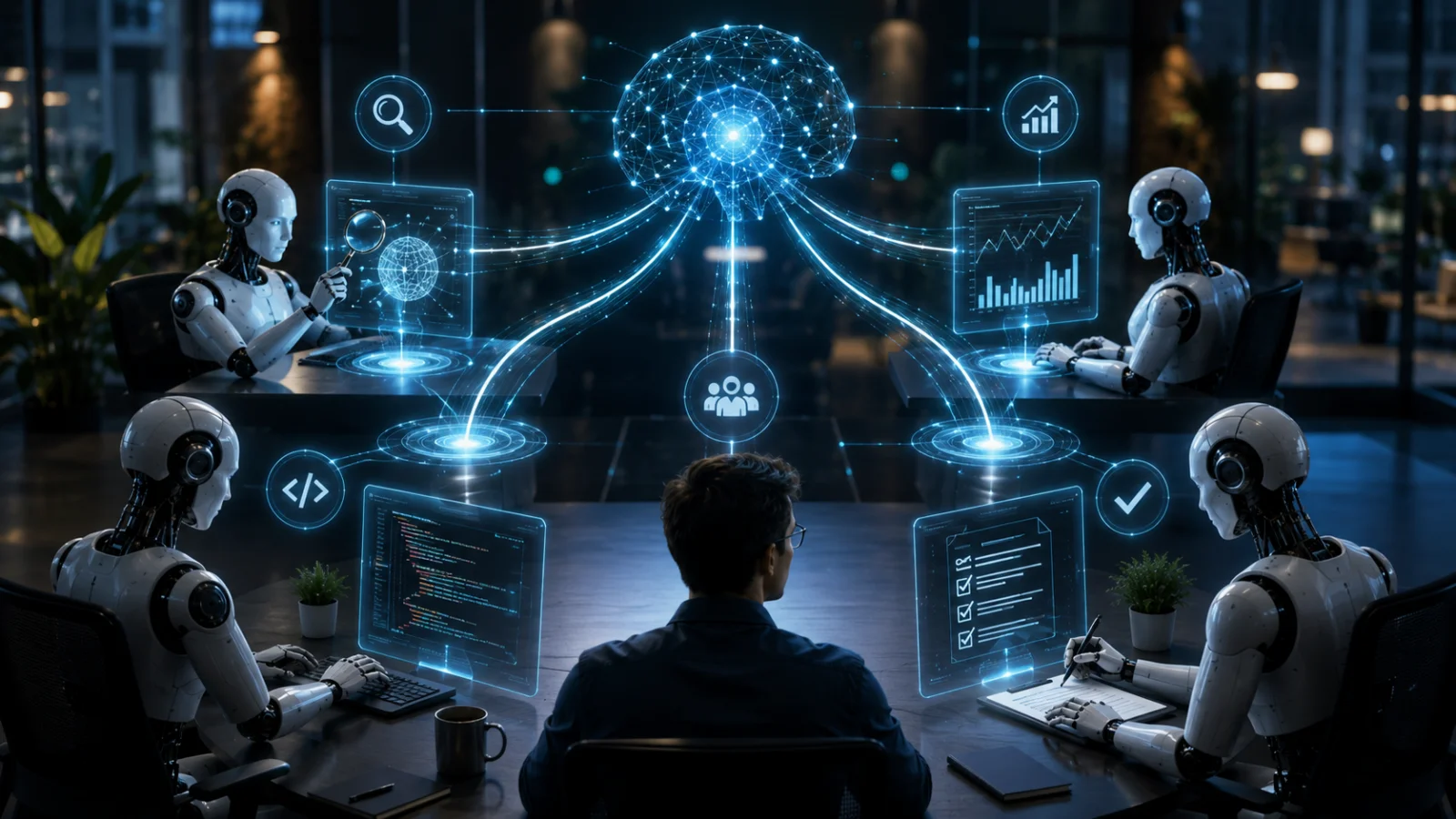
Orchestration means directing multiple AI models, tools, and agents so that they work together toward the same goal. One agent might retrieve information, another analyze it, a third write the report, and a fourth check the quality. An agent farm is a group of AI agents with their own roles and tasks — the idea resembles a small digital team: researcher, project manager, coder, and quality assurance specialist. Built well, this can speed up multistep work; built poorly, it can produce a lot of errors very quickly.
Käytännön vinkki: Aloita pienestä. Älä rakenna heti kymmentä agenttia, vaan määritä ensin yksi selkeä työnkulku: esim. "hae tieto → tiivistä → tarkista lähteet → muodosta raportti".
Orchestration and agent farms — the next step in AI is not a single genius, but a well-led digital team
A single agent can be a skilled individual performer. Orchestrated agents are a small digital team: one searches, another analyzes, a third writes, a fourth reviews — and a fifth decides what happens next.
1. Introduction: why one AI is not always enough
The first wave of AI got us asking: what can a single model do? It can write an email, summarize a document, code a small app, analyze feedback and brainstorm a marketing campaign. That is quite a lot for one tool.
But work rarely consists of a single task. Real work looks like this: you search for information, evaluate sources, compare options, make a decision, write a report, check the quality, enter the information into a system and track the impact.
At that point, a single AI model starts to resemble a skilled individual performer trying to run an entire project alone.
Orkesterointi ja agenttifarmit tuovat tähän toisenlaisen ajatuksen: entä jos tekoäly ei olisi yksi työkalu, vaan pieni digitaalinen tiimi?
One agent searches for information. Another analyzes it. A third writes. A fourth reviews. A fifth decides what happens next.
Built well, this can speed up multistep expert work. Built poorly, it can be like a meeting where everyone talks over each other, nobody checks the facts and the result looks convincing but is wrong.
Siksi aiheesta kannattaa puhua nyt: agentit ovat siirtymässä demojen maailmasta yritysten työnkulkuihin. Microsoft kuvaa Agent Frameworkia työkaluksi, jolla rakennetaan yksittäisiä agentteja ja monen agentin työnkulkuja .NET- ja Python-ympäristöissä.[1]
2. What does orchestration mean?
Orchestration means directing multiple AI models, tools, data sources and agents toward the same goal.
The idea is the same as in an orchestra. The violinist, cellist, trumpeter and percussionist may all be brilliant. But without a conductor, a score and a shared rhythm, you easily end up with noise, not music.
In AI, orchestration answers these questions:
- who does what,
- in what order the tasks are done,
- what information is passed to the next agent,
- when the work stops,
- when a human is asked to make a decision,
- how errors are detected,
- how the final result is checked.
LangChainin dokumentaatio kuvaa monen agentin järjestelmät erikoistuneiden komponenttien koordinointina monimutkaisten työnkulkujen ratkaisemiseksi, mutta muistuttaa samalla tärkeästä asiasta: kaikki monimutkaiset tehtävät eivät tarvitse monen agentin rakennetta. Joskus yksi agentti ja hyvät työkalut riittävät.[2]
Tämä on hyvä vastalääke hypelle. Orkesterointi ei tarkoita, että jokainen prosessi pitää muuttaa agenttien sirkukseksi. Se tarkoittaa, että monivaiheinen työ voidaan jakaa hallitusti osiin.
3. What is an agent farm?
An agent farm is a group of AI agents, each with its own role and tasks. It might look like this, for example:
- a researcher agent gathers information,
- an analyst agent evaluates the findings,
- a writer agent produces the report,
- a quality assurance agent checks the claims,
- a project manager agent steers the progress of the work.
Agenttifarmi ei välttämättä tarkoita satoja agentteja. Usein hyvä alku on kolme tai neljä. Tärkeintä ei ole määrä, vaan työnjako.
A poorly designed agent farm is like a startup where everyone has a fancy title but nobody knows who makes the decisions. A well-designed agent farm is like a small, effective team where everyone has a clear role, defined responsibilities and a shared goal.
4. Agent, tool and automation — what is the difference?
This is where terms easily get mixed up.
Tekoälymalli on perusmoottori. Se tuottaa tekstiä, luokittelee, päättelee tai käsittelee tietoa.
Työkalu on jokin toiminto, jota malli voi käyttää. Esimerkiksi verkkohaku, tietokantakysely, laskuri, kalenteri, CRM-järjestelmä tai sähköpostin lähetys.
Automaatio tekee ennalta määriteltyjä vaiheita. Esimerkiksi: jos lomake täytetään, lähetä sähköposti.
Agentti on järjestelmä, joka voi tavoitteen saatuaan päättää seuraavista askelista, käyttää työkaluja ja edetä tehtävässä jossain määrin itsenäisesti.
Yksinkertainen vertaus: Automaatio on kuin liukuhihna — se tekee saman asian uudelleen. Agentti on kuin assistentti — se tulkitsee tilanteen, valitsee työkalun ja yrittää päästä tavoitteeseen.
Orchestration, in turn, is a way of managing several assistants so that they do not duplicate each other’s work or get in each other’s way.
5. Why does orchestration work?
Orchestration works because much work naturally unfolds in stages. People divide work into roles, too. Few good organizations ask one person to simultaneously research the market, write a contract, check the legal risks, build a financial model and approve the final result.
In AI, the same logic can improve quality. One agent can focus on one task. Its instructions can be more precise, its work easier to evaluate and its mistakes easier to spot.
For example, when producing a report, the workflow could be:
- Find sources.
- Extract the key claims.
- Check for contradictions.
- Write a draft.
- Check the facts.
- Edit for readability.
- Write the final summary.
This is often better than a single prompt: “Write a perfect report on everything.”
Orkesteroinnin ydin ei siis ole agenttien määrä. Ydin on työnkulun suunnittelu.
6. When is an agent farm useful?
An agent farm is worth building when a task is multistep, recurring, requires different areas of expertise, needs checks, matters to the business, is too broad for a single prompt, or is one where errors must be caught before the final result.
Good use cases include:
- producing customer reports
- market and competitor monitoring
- analyzing requests for proposals
- software development support processes
- classifying and analyzing customer feedback
- initial triage of security incidents
- first-pass review of legal documents
- sales processes
- recruitment support tasks
- investigating anomalies in financial administration
But an agent farm is not the right solution for everything. If a task is simple, one good AI assistant is enough. If the data is bad, an agent farm will not save it. If a process is unclear to people, it is even less clear to agents.
Tämä on yksi tärkeimmistä opeista: älä automatisoi kaaosta.
7. The business perspective: taking digital workflows to the next level
Orchestration is interesting for companies because it can turn AI from a standalone helper into part of the work process.
Until now, many organizations have used AI like this: an employee opens a tool, writes a request, copies the answer, edits it and moves the work forward.
An orchestrated agent system works differently: the workflow is triggered by, for example, a customer service request, a request for proposal or a new document. The agents process it step by step, use the necessary systems, propose a decision and ask a human for approval at the critical point.
This can bring three major benefits:
Ensinnäkin nopeus. Monivaiheinen työ voi edetä ilman, että ihminen kopioi tietoa järjestelmästä toiseen.
Toiseksi tasalaatuisuus. Sama työnkulku voidaan toistaa samalla rakenteella.
Kolmanneksi läpinäkyvyys. Hyvin suunniteltu järjestelmä jättää jäljen: mitä tehtiin, millä tiedolla ja missä kohtaa ihminen hyväksyi lopputuloksen.
Mutta tämä vaatii hallintaa. NISTin tekoälyn riskienhallintakehys painottaa tekoälyriskien johtamista organisaation, yksilöiden ja yhteiskunnan näkökulmasta. Generatiivisen tekoälyn profiilissa esiin nousevat muun muassa tietosuoja, informaation eheys, tietoturva, vinoumat ja arvoketjun riskit.[3]
Agenttifarmissa nämä riskit eivät vähene. Ne moninkertaistuvat, jos jokainen agentti saa liikaa valtaa, liikaa dataa ja liian vähän valvontaa.
8. The startup perspective: a small team can build a big machine
For a startup, an agent farm can be a tempting superpower. A small team can build processes that would previously have required many people. Sales can enrich leads. Customer support can structure tickets. Product development can get help with code review. The founder can monitor the market more automatically.
But startups in particular should be careful. An agent farm can look amazing in a demo and fall apart in production. It can get 80 percent right and 20 percent dangerously wrong. It can drive up cloud costs unexpectedly. It can handle customer data in ways nobody documented.
Startupin hyvä sääntö on tämä: rakenna agenttifarmi vasta, kun tiedät, minkä työnkulun se korvaa tai vahvistaa.
Not like this: “We need to have agents.”
But like this: “Every week we get 200 customer support requests, 60 percent of which need to be classified, summarized and routed to the right team. We will build an agent workflow for that.”
That is a much better starting point.
9. The technological perspective: how do agents actually work together?
Multi-agent systems use a few common patterns.
1. The chain pattern
One agent completes the first step and passes the result to the next. For example: search → summary → analysis → report → review. This is a good starting pattern because it is clear.
2. The supervisor pattern
One agent acts as the coordinator. It decides who gets the task next. For example, a project manager agent assigns tasks to the researcher, the writer and the reviewer.
3. The parallel pattern
Several agents work at the same time. For example, three agents analyze the same market from different angles: customer, competitor and technology.
4. The conversation pattern
Agents talk to each other and refine the solution. This can be useful for brainstorming, but the risk is a long, expensive and hard-to-control conversation.
5. The human-in-the-loop pattern
Agents do the preparation, but a human approves important decisions. For many companies this is the most sensible pattern, especially when customers, money, contracts, personal data or reputation are involved.
Microsoftin Azure-arkkitehtuuriohjeistus kuvaa useita agenttien orkestrointimalleja, kuten peräkkäisiä, rinnakkaisia, ryhmäkeskusteluun perustuvia ja tehtävänsiirtoon perustuvia malleja.[4]
10. Concrete examples
Example 1: a market report
Huono: Yritys rakentaa kymmenen agenttia: yksi hakee uutisia, toinen lukee somea, kolmas analysoi kilpailijoita, neljäs tekee johtopäätöksiä, viides kirjoittaa raportin ja loput ”sparraavat”. Kukaan ei määrittele lähteitä, tarkistussääntöjä tai lopputuloksen rakennetta. Tuloksena syntyy pitkä raportti, jossa on uskottavia väitteitä, mutta osa lähteistä on heikkoja ja osa johtopäätöksistä arvailua.
Parempi: Työnkulku rajataan: 1) Hae viisi luotettavaa lähdettä. 2) Tiivistä jokainen lähde. 3) Nosta kolme havaintoa. 4) Merkitse epävarmat kohdat. 5) Kirjoita raportti. 6) Ihminen tarkistaa.
Erinomainen: Järjestelmä käyttää hyväksyttyjä lähteitä, tallentaa lähdeviitteet, näyttää epävarmuudet, erottaa faktat tulkinnoista ja lähettää raportin asiantuntijalle hyväksyttäväksi ennen jakelua.
Example 2: handling customer service tickets
Huono: Agentti lukee asiakkaan viestin ja vastaa automaattisesti ilman tarkistusta. Se tulkitsee reklamaation väärin ja lupaa hyvityksen, johon yrityksellä ei ole käytäntöä.
Parempi: Ensimmäinen agentti luokittelee tiketin. Toinen tiivistää sen. Kolmas ehdottaa vastausta. Ihminen hyväksyy.
Erinomainen: Agenttijärjestelmä tunnistaa riskitapaukset: vihaiset asiakkaat, juridiset uhkaukset, terveystiedot, isot hyvitykset ja mahdolliset tietoturvatilanteet. Nämä ohjataan automaattisesti ihmiselle.
Example 3: software development
Huono: Koodari-agentti tekee muutoksia suoraan tuotantokoodiin. Testiagentti väittää testien menneen läpi, mutta ei oikeasti aja niitä.
Parempi: Agentti ehdottaa koodimuutoksen. Toinen agentti tekee katselmuksen. CI-järjestelmä eli automaattinen testausputki ajaa testit. Ihminen hyväksyy pull requestin.
Erinomainen: Agentit toimivat vain rajatussa kehitysympäristössä, eivät pääse tuotantoon, kaikki muutokset ovat versionhallinnassa ja turvallisuustarkistus on pakollinen.
11. Risks and pitfalls
1. Errors scale
Yksi tekoäly voi tehdä virheen. Agenttifarmi voi tehdä virheen, välittää sen eteenpäin ja rakentaa sen päälle lisää virheitä. Tämä on agenttifarmien suurin vaara: huono lopputulos voi syntyä nopeasti ja näyttää huolellisesti tehdyltä.
2. Accountability gets blurred
When many agents contribute to a result, who is accountable? The answer cannot be “the system.” The organization must define an owner, an approver and a supervisor.
3. Costs spiral out of control
Many agents often mean many model calls, lots of intermediate steps and more compute. If the system starts talking to itself for too long, costs can rise without any improvement in quality.
4. Too much autonomy too soon
On eri asia antaa agentin luonnostella raportti kuin antaa sen lähettää tarjous, muuttaa asiakastietoja tai tehdä maksupäätös. Autonomia pitää ansaita vaiheittain.
5. Context falls apart
When information passes from one agent to another, essential details can get lost. That is why you need to decide what information is passed on, in what format and at what level of detail.
6. Agents reinforce each other’s mistakes
Jos yksi agentti tekee väärän oletuksen ja toinen hyväksyy sen ilman aitoa tarkistusta, järjestelmä voi luoda valheellisen varmuuden. Laadunvarmistaja-agentti ei saa olla pelkkä kumileimasin.
7. Privacy and access rights get forgotten
Not every agent should see all the data. A researcher agent does not necessarily need the customer database. A writer agent does not need national ID numbers. A quality assurance agent does not need payment details.
Hyvä agenttifarmi noudattaa vähimmän oikeuden periaatetta: jokainen osa saa vain sen tiedon ja pääsyn, jota se tarvitsee.
12. The ethical and leadership perspective
Agenttifarmi ei ole vain tekninen järjestelmä. Se on johtamismalli.
When an organization builds agents, it is also making decisions about power, accountability and work. Who gets to decide what an agent does? Which tasks can be handed to a machine? Where does a human retain decision-making authority? How are employees told that part of their work is being automated? How do you make sure an agent does not treat customers or employees unfairly?
A technical answer is not enough for these questions. You need ground rules.
Hyvä periaate on tämä: mitä suurempi vaikutus ihmisiin, rahaan, oikeuksiin tai turvallisuuteen, sitä vahvempi ihmisen rooli.
An agent farm can prepare. It can propose. It can check. But at critical points, a human must understand what the system did and why.
13. The future: agents are coming, but not by magic
1. Agents move from isolated experiments into work processes
AI is no longer just a chat window. It is becoming part of CRM, financial management, customer service, document systems and software development.
2. Agent management becomes a discipline of its own
Yritykset tarvitsevat rekisterin agenteista samaan tapaan kuin käyttäjistä, sovelluksista ja integraatioista. Microsoftin Agent 365 -uutisoinnissa korostui juuri tämä: yritykset tarvitsevat tapoja hallita, valvoa ja turvata agentteja keskitetysti, samaan tapaan kuin ne hallitsevat työntekijöiden käyttöoikeuksia.[5]
3. The human-in-the-loop pattern is here to stay
Fully autonomous agent farms sound intriguing, but in many business processes humans will stay involved for a long time. Not because AI is useless, but because accountability rests with people and organizations.
4. Quality assurance becomes the most important layer
Building agents is getting easier. Evaluating them reliably is harder. The winners will be organizations that know how to measure agent quality, catch errors and build safe stopping points.
5. Small, scoped agent workflows deliver the most value first
Suurin arvo ei todennäköisesti synny heti ”tekoälytoimitusjohtajasta” tai täysin autonomisesta digiyrityksestä. Se syntyy arkisista työnkuluista: tarkista tämä, hae tämä, tiivistä tämä, luokittele tämä, ehdota seuraava askel, varoita jos jokin näyttää oudolta. Tylsä kuulostaa usein juuri siltä, mikä toimii.
14. Conclusions
Orchestration and agent farms are the natural next stage in the evolution of AI. When a single AI model can do so much, the next question is: how do you connect its capabilities to real work?
Vastaus ei ole ”enemmän agentteja”. Vastaus on parempi työnkulku.
An agent farm is worth building only when the task is clear, the data is under control, responsibilities are defined and quality assurance is built in from the start.
At its best, an agent farm is a digital team that frees people from routine legwork and gives them more time for decisions, creativity and customer work. At its worst, it is an automated error factory.
Start small. Define the roles. Measure the results. Don’t hand responsibility to a system you don’t yet understand.
15. Practical frameworks, checklists and templates
A. A beginner’s agent workflow
Aloita tällä: Hae tieto → tiivistä → tarkista → muodosta raportti → ihminen hyväksyy
This is enough for many first experiments. Don’t start with ten agents. Start with one workflow that has a clear beginning and end.
B. Decision model: do you need an agent farm?
Ask these questions:
- Is the task multistep?
- Does the task come up frequently?
- Does it require different areas of expertise?
- Can the quality of the result be measured?
- Is the data available securely?
- Can the work be paused for human review?
- Do errors have significant consequences?
If you answer yes to items 1–4, an agent workflow may be useful. If you answer no to items 5–7, don’t take it into production yet.
C. A role map for agent farms
A good first structure:
- 1. Orkestroija — jakaa tehtävät ja päättää etenemisjärjestyksen.
- 2. Tutkija — hakee ja kokoaa tietoa.
- 3. Analyytikko — etsii olennaiset havainnot ja ristiriidat.
- 4. Kirjoittaja — muotoilee lopputuloksen ihmiselle ymmärrettäväksi.
- 5. Tarkistaja — tarkistaa lähteet, säännöt, rakenteen ja riskit.
You don’t always need all of them. Three is often enough.
D. The green–yellow–red model
Vihreä (hyvä aloituskohde): julkisen tiedon tiivistäminen, sisäisten ohjeiden hakeminen hyväksytystä tietopankista, raporttiluonnosten tekeminen, asiakaspalautteen anonymisoitu luokittelu, markkinaseurannan alustava koonti.
Keltainen (vaatii valvontaa): sopimusluonnosten analyysi, asiakasviestien luonnostelu, myyntiprosessin tukeminen, rekrytoinnin avustavat tehtävät, ohjelmistokoodin ehdottaminen.
Punainen (älä automatisoi ilman vahvaa hallintaa): lopulliset rekrytointipäätökset, terveyteen liittyvät päätökset, luottopäätökset, oikeudellisesti sitovat päätökset, maksujen hyväksyntä, tuotantoympäristöön tehtävät muutokset, henkilötietojen laajamittainen käsittely.
E. An agent workflow design template
Fill in before building:
- Workflow name:
- What problem it solves:
- What triggers the workflow:
- What data is needed:
- What data must not be used:
- Which agents are needed:
- What each agent’s role is:
- Which tools the agents may use:
- At which point a human reviews:
- How success is measured:
- How errors are detected:
- How costs are tracked:
- Who owns the workflow:
F. A quality assurance checklist
Before production use, make sure:
- The agents’ roles are clear.
- Each agent has a scoped task.
- The system does not process unnecessary data.
- Sources are recorded.
- Intermediate steps can be inspected.
- Critical points require human approval.
- There is a procedure for error situations.
- Costs are tracked.
- Access rights are restricted.
- Results are compared with work done by humans.
- Agent behavior is also tested with edge cases.
- Nobody can say: “I don’t know why the agent did that.”
G. A first hands-on experiment
Vaihtoehto 1: raporttiagentti. Tutkija hakee aineiston. Tiivistäjä tekee koonnin. Tarkistaja merkitsee epävarmat kohdat. Kirjoittaja tekee raportin. Ihminen hyväksyy.
Vaihtoehto 2: asiakaspalauteagentti. Luokittelija jakaa palautteet teemoihin. Analyytikko etsii trendit. Kirjoittaja tekee yhteenvedon. Tarkistaja nostaa riskikommentit. Ihminen päättää toimenpiteet.
Vaihtoehto 3: myynnin valmisteluagentti. Tutkija hakee julkista tietoa asiakkaasta. Analyytikko tunnistaa mahdolliset tarpeet. Kirjoittaja luonnostelee kontaktointiviestin. Tarkistaja varmistaa, ettei viesti väitä liikaa. Myyjä lähettää tai muokkaa.
H. The one-sentence summary
Orchestration and agent farms are not a magic trick, but a way of leading AI like a digital team: the right role, the right information, the right order and a human involved where accountability truly matters.
Sources
- Microsoft Agent Framework Overview — Microsoft Learn
- Multi-agent — LangChain Docs
- AI Risk Management Framework — NIST
- AI Agent Orchestration Patterns — Azure Architecture Center
- Microsoft Agent 365 lets businesses manage AI agents like they do people — The Verge

Innohub TV
Watch this content also on Innohub TV
We picked clips from Innohub TV that continue the same topic.